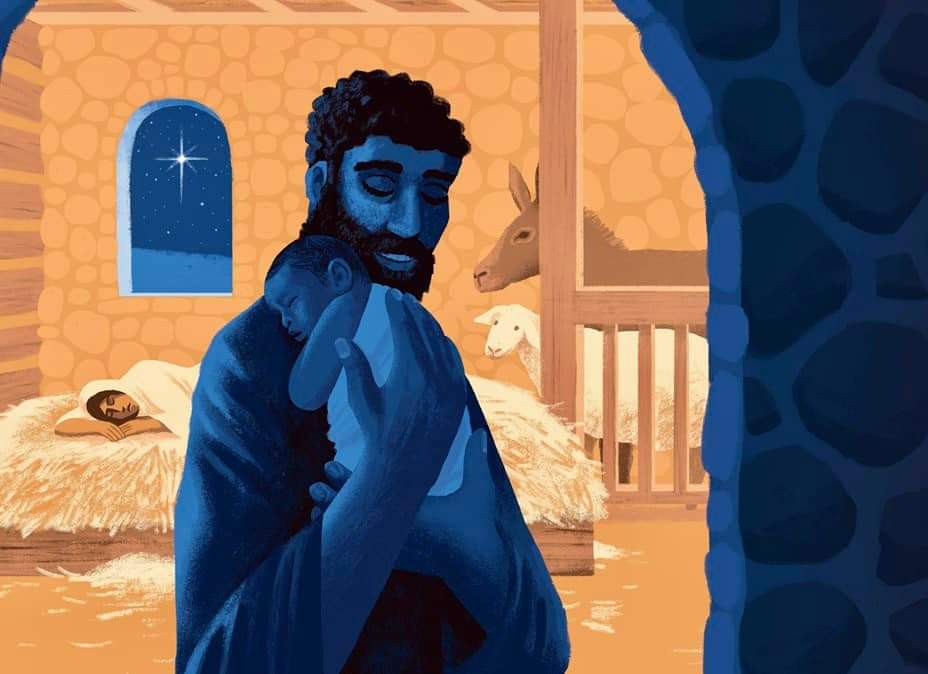
We think of him as safe beneath the steeple, Or cosy in a crib beside the font, But he is with a million displaced people On the long road of weariness and want. For even as we sing our final carol His family is up and on that road, Fleeing the wrath of someone else’s quarrel, Glancing behind and shouldering their load.
Whilst Herod rages still from his dark tower Christ clings to Mary, fingers tightly curled, The lambs are slaughtered by the men of power, And death squads spread their curse across the world. But every Herod dies, and comes alone To stand before the Lamb upon the throne.
Take all your hope and longing; cover it in blood, urine, faeces, straw.
Cut the chord to your dreams with a field knife or clenched jaw. Here lays the King of the Jews. Crowned between thighs, Held in arms of exhaustion.
Bathed with tears, sweat and the soft tones of a mother singing songs of deliverance between breaths as the King of Glory feeds folded at her breast.
What newborn would you not bend a knee for? What labouring mother would not make room for life?
Here’s how God chose to be with His beloved; in a state of utter surrender and dependence; making His way into the world through a uterus. Trading a heavenly crown for one of mucus. Later, finding woven thorns pushed in its place as, once again, God surrenders to the fulness of humanity’s mess – reconciling it all to Himself; counting no soul’s sin against them.
from Winters Never Last: Poetry Chapel vol 2. 2021.
Now the birth of Jesus the Messiah took place in this way. When his mother Mary had been engaged to Joseph, but before they lived together, she was found to be with child from the Holy Spirit.Her husband Joseph, being a righteous man and unwilling to expose her to public disgrace, planned to dismiss her quietly. But just when he had resolved to do this, an angel of the Lord appeared to him in a dream and said, “Joseph, son of David, do not be afraid to take Mary as your wife, for the child conceived in her is from the Holy Spirit. She will bear a son, and you are to name him Jesus, for he will save his people from their sins.” All this took place to fulfill what had been spoken by the Lord through the prophet: “Look, the virgin shall conceive and bear a son, and they shall name him Emmanuel,” which means, “God is with us.” When Joseph awoke from sleep, he did as the angel of the Lord commanded him; he took her as his wife, but had no marital relations with her until she had borne a son; and he named him Jesus. [Matthew’s Gospel 1.18-25]
Not a word is spoken by him. He waits, in the shadows. In his dreams, an angel challenges him to find courage to stand with Mary. He remains, faithfully, with her, enduring the questions and snide comments, which will remain.
Joseph’s story begins, shrouded in hesitation. The lineage Matthew offers us has characters hinting at splintered lives and relationships, and some names which have been grafted into the Jewish family tree.
In contrast, Luke’s Gospel offers us two women, courageous and prophetic, embodying hope. Angels are everywhere, in light and triumph, while Mary’s proclamation is unequalled in all the gospel.
Matthew’s offering may well be the one we need in this week. Not only Joseph’s story is shadowed, but possibilities of harm hover all around. The social cost – and risk – borne by these two people, elected by God; the darkness at the centre of which Herod sits, frightened by the possibility of a rival; the new family’s flight into refuge, narrowly avoiding Herod’s mass infanticide.
Those winsome carols about Emmanuel have never been more accurate, despite themselves.
We have been appalled at two terrorists’ attacks on a peaceful Jewish community gathering. Matthew’s story about Jesus’ birth attends to our fears and grief more acutely than tinsel and nostalgia.
The gospel story does not ignore the reality around Jesus, or around us. Jesus is not born despite our world’s woundedness, but because of it. Jesus is delivered under the heel of empire, in a community infected by the corruption of puppet rulers and those enthralled to them.
Jesus and his family are not strangers to violence of the kind we have witnessed in recent days. As we seek to navigate our community’s grief and fear, we name our hope that God is, indeed, with us, and all who suffer.
Our call is not only to assert that hope. We need to articulate it in the face of both calculated and reflexive racism, of political point-scoring, of those taking advantage of suffering and grief and anger.
Hope discovered in Christ is not about a sunny disposition, but a belief that forgiveness, healing and restoration are possible, that God attends to our lives and our world, by becoming like us – fully human, not limited by faith, or politics, or race, or gender. God has acted to save – all of us.
Emmanuel, God is with us. As we find our way to a manger and a tiny child within, we offer a story, with gentle hands and open, obedient hearts; our story is that God is with us, in every circumstance. This is how we will navigate tragedies, like Bondi, like Gaza, like ongoing Aboriginal deaths in custody.
God has moved to be with us, like us, in love. It is here that we begin, again.
When John heard in prison what the Messiah was doing, he sent word by his disciples and said to him, “Are you the one who is to come, or are we to wait for another?” Jesus answered them, “Go and tell John what you hear and see: the blind receive their sight, the lame walk, the lepers are cleansed, the deaf hear, the dead are raised, and the poor have good news brought to them. And blessed is anyone who takes no offense at me.” [Matthew’s Gospel 11.2-6]
On occasions, I have little rituals for how I do things, whether it’s preparing for worship, or starting the mower, or when I am driving my car. I like things in place, and those I love will tell you this is of no inconvenience to them whatsoever, neither is there impatience on my behalf, when the system is disrupted.
Sometimes, people make suggestions how I might alter (improve) these idiosyncratic things. Traditionally, I nod benignly and carry on; in my better moments I address my discomfort, and consider change.
We have prescribed rituals in the life of the church, however, it is frequently the unwritten rules which guide our behaviours as communities of faith. As we journey through Advent and approach Christmas, the cultural rituals – helpful and otherwise – become more pronounced.
There are things we need for “a proper Christmas”, whether it’s the menu, or people we invite, or songs we sing, or stories we tell, or topics which are forbidden at the table. There’s also a sense of how it supposed to feel around this time of year: “It won’t feel like Christmas until the tree is up”.
It’s ironic that a story of profound disruption – teenage pregnancy, demands of empire, risky birth, death threats – we ensure is swaddled in culture and lying in tradition.
What is so scandalous about what Jesus brings? When John sends his disciples to question Jesus, doubts have crept in; being imprisoned can’t have helped. John had an image of what the Messiah was going to bring. It appears that Jesus doesn’t fit.
Consider all the expectations we have of Jesus – and his Church. The indicators of success in the church community are so often seen as numbers in worship, or the amount of money given, or the size of our ministry team. It’s about us.
John is seeking revolution, articulated by a prophet who will lead the march against corruption, injustice and perhaps even empire. From his cell he hears nothing. Is it all wasted?
Our worst moments of fear are that we have wasted our time. That it has all been for nought. All the measurements to which we are accustomed seem to remain unmoved.
Mother & child; Gaza 2025
Then we hear Jesus’ scandalous answers, matching his ministry.
Those who are on the margins, the outcast and the poor, those disabled physically and socially – those who are deemed to be not worth counting – have the good news offered to them, as healing and life.
People are gathered into meaningful community and are restored. The scandal is that those who are marked as worthless are the focus of Jesus’ ministry; a metric of offense, indeed.
This is not what John expected, even intended. So often, neither do we. We had a mission plan: to invite the people like us, who will increase the offerings and populate the pews, and then we will be alright.
Then Jesus leads us to those who have no names and fractured faith, asking us to welcome them, feed them, clothe them, sit with them and, perhaps, advocate for them at some point. And we become them, and they become us.
Change is difficult, especially when it’s culturally embedded. We are easily offended when Jesus doesn’t behave the way in which we expect, then has the temerity to ask us to follow.
At the heart of Christmas is the assertion that God has come for us – all of us. The scandal of this assertion is that God has become like us – every one of us.
“From the fig tree learn its lesson: as soon as its branch becomes tender and puts forth its leaves, you know that summer is near.So also, when you see all these things, you know that he is near, at the very gates.” [Matthew’s Gospel 24.32-33]
All around us, the season has turned towards harvest. Our family makes our home on Gomeroi country in the north west of the state, and it has been a fine season leading up to harvest, with crops looking promising and feed in the paddocks. It hasn’t been so good in other regions, but there is heightened sense of hope for many in our community.
Driving at night, there is the alien glow of lights as headers move through the darkness, racing the season and the hints of storm and rain. The farming community has been preparing for weeks and months; servicing headers, organising contractors, ordering fuel, watching the crops, watching the weather. Waiting.
Advent is this unsettling season, preparing for something which has already happened and asserting something which hasn’t yet occurred. Advent: the season of now and not yet.
Waiting isn’t passive. It isn’t sitting outside the supermarket, while your partner grabs the groceries. Jesus tells us to take note of the times around us, and to be ready, to wait – with purpose.
It can be a difficult season, waiting. There are constant signs of brokenness, as the world seems bent on self-destruction. Yeats writes “things fall apart, the centre cannot hold”, and his words sound prescient, yet it was written over a century ago, in the ashes of the First World War. Jesus himself spoke under the tyranny of empire.
The truth is that tyrants have always been rising, that presidents and dictators and monarchs have always invaded and enslaved and destroyed, while others have enabled and appeased.
We cannot wait for the storm to pass; we are here, whatever the weather. Our calling is to live out the promise which has given us life, in which our hope is placed.
Whatever the return of Christ entails, whatever it means, it is not ours to know, to control, or to decide. It is not for us to mark our calendars, but to wait with the intent Jesus asks of us. Pessimism disables us, seeing no path forward, so we wait in despair, for an end. Optimism can be equally disabling, as we wait passively for a better season, a better leader, denying the reality of the world in which we are living.
The hope found in Jesus enables our waiting. This is the season in which we are called to live – and to act. Our readiness acknowledges what God in Christ has already done; this informs our forgiveness, our humility and our repentance. It equally informs how we live for those around us, active for justice and hope in their lives even more than our own.
In Advent we name that God in Christ has appeared and assert that Christ will come again. We live and act in hope, because God’s promise in Christ has been realised and we believe that God in Christ will do so again.
So we will wait, and feed those who are hungry and stand against those who act in harm, or injustice.
We will wait, and seek and offer forgiveness, because that is the essence of the life offered in Jesus. We will wait, and weep with those who weep, and embody the hope which shapes our worship and our witness.
We will wait, together, because sometimes our courage fails us, and we need others around us and the Spirit of God to hold us, and to help us to remember and look forward.
Then I myself will gather the remnant of my flock out of all the lands where I have driven them, and I will bring them back to their fold, and they shall be fruitful and multiply. I will raise up shepherds over them who will shepherd them, and they shall not fear any longer, or be dismayed, nor shall any be missing, says the Lord. [The Prophet Jeremiah 23.3-4]
As if the lessons from history aren’t enough. As if the depredations of monarchs and dictators from the last century, alone, haven’t taught us to be wary. As a cautionary tale, last century was redundant, with lessons before us since Rachel was weeping for her children.
Even now, we vote them in, these narcissistic populists of all shapes and predilection, or permit these diminished princes who behave as they please, to others’ destruction.
The Old Testament – and other – prophets warned their communities and their words resonate, yet still we tick the ballot box and bow the knee.
On this last Sunday of the Church year, this Sunday when we proclaim the Reign of Christ, the bells of alarm toll more loudly than ever.
There will be songs to sing of the risen Christ’s majesty and wonder, and they need to be sung. We assert the Reign of the crucified, risen One to the glory of God, and for our hope in this life.
And yet this tapestry has more than simply threads of gold.
On this Sunday, the Gospel readings speak of one who was marked as criminal, executed between two thieves. Our faith directs us away from the self-interest of political hacks and those entitled by bloodline towards a monarch who is most clearly identified by nails and a garland of thorns.
We are astonished, if we pay attention. Our lives are transformed if we step into the story.
The gilded life has no currency here. There is no resonance with the one who is known by their birthing in a feed trough and cradling on a cross. The God of Christmas and Easter is not found in the excess of the well-appointed, but in the lives we humans lead, lives of wonder and grief, of struggle and friendship, of ordinariness.
To identify a monarch by their brokenness, or their frailty, seems impossible, and yet that is both where we find Jesus and, so frequently, where we find ourselves. What is more, that is where we need Jesus to be, for those who have no recourse, and who believe there is no hope.
Jesus is born and dies outside the ambit of a just authority, and yet we place our hope in Jesus precisely for that reason. Christ’s resurrection asserts that all the rules are turned upside down, and are now located in the mercy and love of God.
Jeremiah reminds us that “nor shall any be missing” from the merciful embrace of God. And a crucified criminal finds not just understanding, but life, beside Jesus in their last moments; “today you will be with me in Paradise.”
“… they will arrest you and persecute you; they will hand you over to synagogues and prisons, and you will be brought before kings and governors because of my name. This will give you an opportunity to testify. So make up your minds not to prepare your defence in advance; for I will give you words and a wisdom that none of your opponents will be able to withstand or contradict. … and they will put some of you to death. You will be hated by all because of my name. But not a hair of your head will perish. By your endurance you will gain your souls. [Luke’s Gospel 20.12-19]
What shape could our discipleship to Jesus possibly take, that this story would have any resonance? What might we say in public, or public worship, which would be this costly?
We know the historical trials of Christians, and in some nations even now. In comparison, the whimpers from segments in the Australian church about persecution from government are more reflective of their discomfort with losing the political influence the church wielded in an earlier era.
Jesus is referring to the faithful actions which may cost everything. In a climate such as the one in which we currently live, what might these costly actions look like?
Prior to his extraordinary words, Jesus has identified the community leaders who “devour widow’s houses” and offer public prayers for the sake of looking impressive. Jesus immediately indicates a poor widow, who gives all she has, offering a direct contrast to those who contributed a fraction of their wealth.
If the church both spoke and acted about the inequity of wealth in our community, what might result? If we acted ourselves to address poverty, would that make a difference? What risk might there be as we confront the government about funding for war and not for the poorest in our community?
In a culture which thrives on punishment and vengeance masquerading as justice, what will it cost to live and speak of peace, forgiveness and real reconciliation?
The dodgy prophets whose concerns are power and self-promotion – seen in pulpit and parliament – will draw us away from the tasks which are central to the gospel. Self-interest is their song, and it lies at the heart of every pitch.
Where do we see Jesus standing? Where is Jesus’ voice most clearly heard? For whom was Jesus most passionately concerned?
This is where we need to be, to act and to speak. And to be under no illusion our actions will be costly. We stand with Christ and, if so, we shall also die – and rise – with him.
The hymn writer, Marnie Barrel reminds us As long as hatred stifles truth and freedom is betrayed by fear, we stand with Christ; give us no peace till his peace reigns in triumph here.
Then Jesus told them a parable about their need to pray always and not to lose heart. He said, “In a certain city there was a judge who neither feared God nor had respect for people. In that city there was a widow who kept coming to him and saying, ‘Grant me justice against my opponent.’ For a while he refused; but later he said to himself, ‘Though I have no fear of God and no respect for anyone, yet because this widow keeps bothering me, I will grant her justice, so that she may not wear me out by continually coming.’” And the Lord said, “Listen to what the unjust judge says. And will not God grant justice to his chosen ones who cry to him day and night? Will he delay long in helping them? I tell you, he will quickly grant justice to them. And yet, when the Son of Man comes, will he find faith on earth?” [Luke’s Gospel 18.1-8]
How comfortable it is to slip into that old pair of shoes we know so well, the ones which have adapted to the shape of our feet, which surrendered any pretence to fashion years ago, and which have so often accompanied us to relaxation. Good memories.
When we pick up bible stories, parables, especially the ones we have heard often, we slip contentedly into the way in which we have always imagined them. They have adapted themselves to our context; we know their measure and their timbre. If we are careful, we can avoid any real disruption.
Then we take the risk of asking someone how they hear the story Jesus tells, this parable of a steadfast woman and an unjust magistrate.
Who is most like God in the parable? Who bears the characteristics of one who is both worthy of worship and worthy of our trust? Who is persistent, faithful and seeking justice? Who reflects the one who seeks us out in love and hope, and will not give up?
Why, so easily, do we content ourselves with a pair of ill-fitting shoes; where a corrupt man of power, with no regard for God – or anyone – grants justice only out of self-interest? In what way is this man similar to God?
Does God require badgering? Does God respond simply from self-interest, in order to silence us?
This woman, this widow, emulates the persistent shepherd whose goodness and mercy pursue us all of our lives. Are there echoes of the Spirit who advocates for us when we can barely find the words, so that our prayers, our entreaties, sound like groans?
When we pray – for healing, or justice, or hope – we imagine a God who loves us beyond measure, and whose compassion is inherent because of the suffering God endures at the brokenness of our world.
This woman refuses to surrender. She insists on justice.
This one will stand with us as we advocate for those who have no voice for themselves. Would she delay in offering us her hand, her voice, her home, her food?
God insists on seeking us out, offering us life, acting to restore all life through the death and resurrection of Jesus. When do we imagine that God ceases to seek life for us, and to offer us mercy? God cajoles us faithfully to act mercifully, to forgive and forgive, to love those who seek us harm. God will not give up on us.
Perhaps we are the ones who need convincing? Perhaps we are the ones who need to change, so that we understand where injustice crouches, and brokenness remains unrelieved. Perhaps this parable offers something entirely new.
Jesus asserts that God is nothing like this corrupted magistrate. Jesus proclaims a God who will not delay justice, who insists on standing with those in need.
When we think we know what God is like, and the manner in which God acts in the world, Jesus draws breath and tells another parable, about a Pharisee and a tax-collector.
Thus says the Lord of hosts, the God of Israel, to all the exiles whom I have sent into exile from Jerusalem to Babylon: Build houses and live in them; plant gardens and eat what they produce. … But seek the welfare of the city where I have sent you into exile, and pray to the Lord on its behalf, for in its welfare you will find your welfare. {The Prophet Jeremiah 29.4-7]
There is a thread at which we are often hesitant to pull, as we think about the place of faith and the faithful, in the scheme of things. It is the thread of punishment and blessing.
The conversation about blessing is often articulated by two statements, one of which appears to follow the other, and which grow progressively threadbare. If we do God’s will, then we will be blessed; the second argument which (for a moment) sounds logical is that if we have wealth and good health, then we must be doing God’s will.
Blessing and obedience are far more nuanced than this utilitarian argument. As if we needed reminding that the most complete act of obedience is found in Christ suffering and crucified; discerning the profound nature of blessing begins and ends there.
Here are God’s people, Jeremiah’s people, bound in exile. Prophets on the right and left are speaking of the escape they must make, or the punishment they must endure. The people look over their shoulders towards the lives they used to live, and remember with some embellishment what life was like, then.
Blessing, or punishment. If we are exiled here, refugees, then Yahweh, our God, has forsaken us. We have no song to sing in this strange land. There is no blessing to be found.
Then God, with the voice of Jeremiah, reminds them of the God who creates, who restores, who wrests life out of death and light from darkness. The whole façade of curse and blessing is allowed to unravel, and God weaves something new – a theology of welfare and of life.
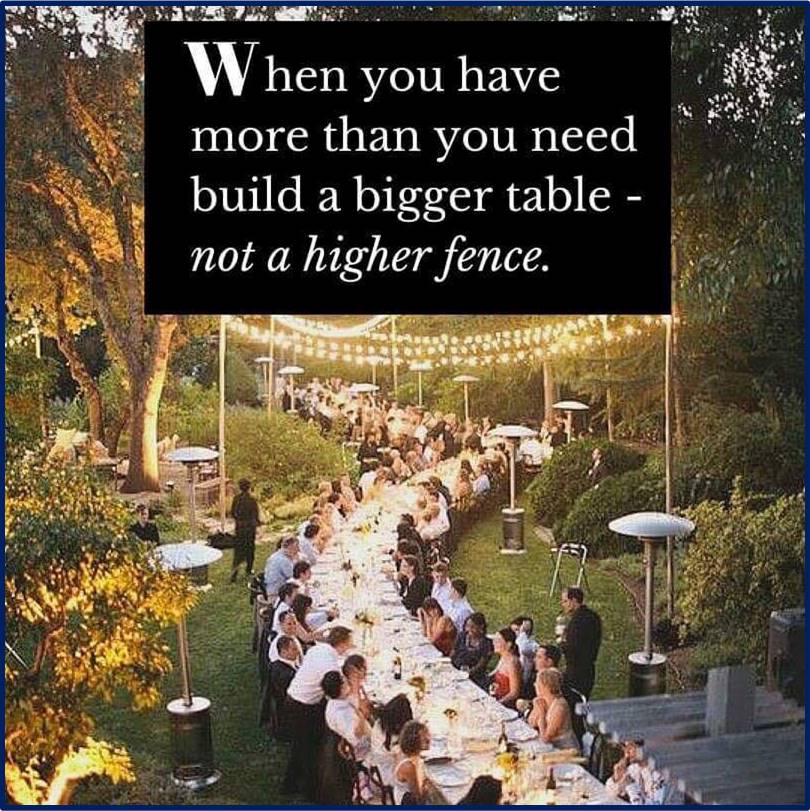
Rather than electing isolation, or social protectionism, the God of Sarah and Abraham calls their descendants to live their reoriented lives entirely in the community into which they have been placed.
“Build and live, plant and eat, marry and grow – live your lives fully in the place where I have located you.” Those who mutter omens of punishment or escape are offering nightmares masquerading as dreams.
It is here, when we think the wells are dry, that we discover who we are called to be. It is when we test our faith, and our faith’s narratives, when we examine the promises of our God and of our journey to this place, that we discern what is myth, what is celebrated and then laid aside, and what gives us foundation for the next steps we need to take.
“Exile is the place where God’s faithful promises work a profound newness”, says Brueggemann. When we offer the gospel as food for the hungry and a voice of justice, but also as celebration and renewal, then lives are changed, not least our own.
We live our faith in such a way, that people are blessed in knowing us. We seek the welfare of our community, because that is best for them. There is no snare in our generosity, to entrap others into faith, or gospel; we serve, and care, and celebrate in order to offer life.
God offers the possibility of return from Babylon to Jersualem and home, but only after three generations of lives have been lived in exile – and in hope.
We are in this place, this life, because God has placed us here. It is in offering life to others, that we discern more fully the lives to which we are called, in Jesus Christ.


 Through A Strained Fence