Singing Hope in the Dark

The crowd joined in attacking them, and the magistrates had them stripped of their clothing and ordered them to be beaten with rods. After they had given them a severe flogging, they threw them into prison and ordered the jailer to keep them securely.  Following these instructions, he put them in the innermost cell and fastened their feet in the stocks.  About midnight Paul and Silas were praying and singing hymns to God, and the prisoners were listening to them.                               [Acts of the Apostles 16.22-25]

A young Warlpiri man, arrested in an Alice Springs supermarket for shoplifting, dies in police custody a few hours later. The authorities “pass on their condolences”.

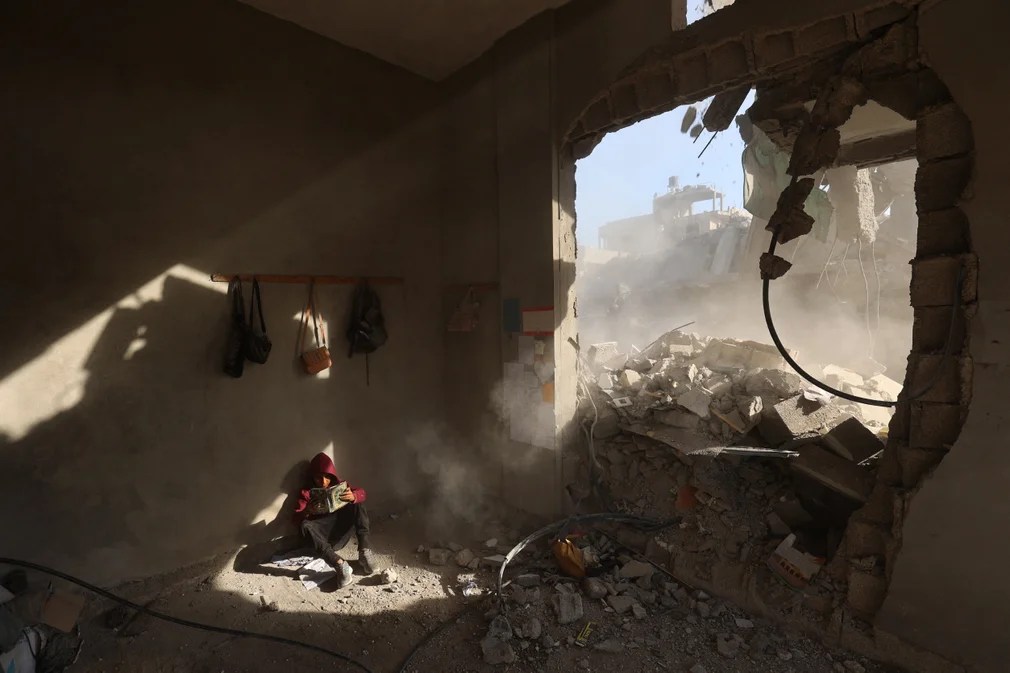
A Palestinian doctor learns that eight of her nine children were murdered by an Israeli airstrike hitting their home. The Israeli Defence Force is “investigating the incident”.

Two Jewish men, Paul and Silas, in Philippi, a Greek city under Roman rule, set a woman free from spiritual – and perhaps physical – slavery. They are arrested, stripped, beaten, shackled and imprisoned.

So, they pray, and sing praises to God.
What faith is this, which sings God’s praise in the darkest cell? What hope is this, which holds when the wounds from our beating are still fresh and our feet are chained?

This has not been an easy week for our Congregation. People we love have died; even as we are thankful for their gifts to us, we grieve their deaths, and our sense of loss. We will care for their families, and for ourselves. Our faith in Jesus, embroidered in our prayers, in our singing and our action, will help us find our way.

I am not sure what capacity for faith the young man’s mother, and grandmother must have in Yuendumu, when the police release his broken body to them. What song might they sing, apart from mourning?

What primal sounds will an Arab mother make at the death of her children? What song, guttural, or ululation, will she raise, if she is able to make any sound at all? I cannot imagine such loss, and the anaesthetising grief with which it is accompanied.

Songs of mourning I begin to comprehend. The communities of Gaza and Yuendumu – amongst many others, now and throughout history – have become accustomed to unjust, sudden death. The “sorry business” journeys of our First Nations communities can sometimes seem almost interminable, as is the generational trauma in which the Palestinians find themselves.

Disciples of Jesus know what it is to sing hope, and praise. When we gather for worship, we remind ourselves of who we are and the One to whom we offer our worship, witness and service.

Do we know what it is to sing defiance and prophecy, to proclaim protest in our song? When Paul and Silas “sang up” the earthquake, foundations were shaken, all chains were broken and prison cells opened wide. Do we imagine they were singing a lullaby to help them sleep? Or were they proclaiming a God who has created the earth, defeated death and saved creation? Is the object of their worship the One who will not be prevented from loving us, who commands us to live justly, to love mercy and to walk humbly, each and every step?

Perhaps we might, instead, sing our songs in parliaments and councils and the streets, and in places where all light and justice appear to have been extinguished. We might sing to politicians and ambassadors that civilians and children are never targets, whatever the infected discourse we bend to our excuses. We might sing of the flawed beauty of each person, their inherent value in the heart of God and, therefore, ours.  

We can sing of One who has died, unjustly, and been raised for everyone, even those who cause the brokenness – on every side.

If I sing Christ’s song of hope, perhaps I will find my name within its lyrics – and my life.

A Life Story Reimagined

One man was there who had been ill for thirty-eight years. When Jesus saw him lying there and knew that he had been there a long time, he said to him, “Do you want to be made well?”     [John’s Gospel 5.5-6]

There he is, on the edge of the picture frame.

As the story takes shape, he lies there, not quite noticed, because he’s part of the furniture. Not the furniture of which anyone takes account, but like the old lounge that mum, and her mum before her, used for spare, if someone, uninvited, stayed the night.

Pushed into the corner. Draped with a dust cover. Just in the corner of your eye.

Like many in the Jesus stories he does not warrant a name, unlike the Sheep Gate, and the Beth-zatha pool, where he has been since before Jesus was born.

Presumably, over the decades, someone has brought him food and clothes; perhaps there are those who offer charity, but not enough companionship to help him move towards healing.

Jesus lifts the dust cover and asks him, ‘Do you want to be healthy?’

So accustomed is he to finding reasons, even excuses, for not being well, that his reply echoes all the other accusations, theologies and stereotypes he has endured. Like the Samaritan woman in the last chapter, they are tattooed into his life.

Thirty-eight years of suffering ends in one sentence from Jesus. No words of thanks, or blessing. Sabbath means not rest for him, but restoration. Shalom indeed.

Then they discover him. Those who ignored, or blamed, or labelled him in the past, the ones our own Manning Clark would certainly have labelled “straighteners” – the punishers of life.

Healing? Be blowed. Sabbath is no time for life and restoration. We know this story all too well; he is only worth their attention when they have something to gain, or some pound of flash to be carved off.

So, why was he there for a lifetime? Did his parents, or siblings, place him there in hope, or despair? Why didn’t they wait long enough to escort him to the pool? Was their compassion – and that of others – exhausted entirely?

Is it possible that his identity, from time and blame, was his illness and nothing else?

We know the answers to none of these questions. We wonder, though, whether he moves from knowing who he is – labelled, disabled and dismissed – to not knowing, now that everything has changed, a lifetime identity transformed.

Is there something in Jesus’ question? “Do you want this?” is something more searching than compassion, perhaps. It is taking someone who has been placed out on the edge of the image, and focusing on them. “Do you want health?” is asking him to reach for more than despair; sometimes despair is the story to which we have become accustomed, and we even believe that might be all we deserve.

The wonderfully ridiculous scene of the “ex-leper” in Python’s Life of Brian, captures this beautifully. Who am I now, if I can’t beg?

We can become content with our circumstances, blaming others, or even ourselves with our inability to find a solution and move on. Healing can be frightening.

And then Jesus.  

Dare we risk ourselves with this Jesus, who will forgive, and heal, and renew? Do we want to be made well? Jesus calls us forward, and his love invites us to imagine – and live – a life shaped by his compassion and mercy, and not by our past.

Do you want to be whole?

Love in a Dangerous Time

“I give you a new commandment, that you love one another. Just as I have loved you, you also should love one another. By this everyone will know that you are my disciples, if you have love for one another.”                 [John’s Gospel 13.34-35]

When we read scripture, one of the cardinal rules is context – location, location, location, as the roadside signs proclaim.

[Momentary Excursus: There was a monstrous (by every definition) sign for a temporary political party in the recent federal election just past Bendemeer, on the way to Armidale and its impact appeared minimal, in terms of votes gained. Perhaps it’s about more than just location…]

If we are careless, we will lift this extraordinary paragraph of Jesus’ words and ignore the path before and behind him. We do this at our peril.

Jesus has just washed the feet of his disciples, shared a meal with them, and Judas has walked into the night. The next moment, Jesus talks about loving each other, which is how people will know that they belong to Jesus.

Immediately, Peter falls into the frame, proclaiming his courage and loyalty, which last less than a few strident heartbeats.

Shortly, Judas’ betrayal will bear its malign fruit, and Jesus will be arrested and taken to the cross.

Jesus’ commandment to love each other describes the core of discipleship, bracketed by betrayal and denial. This is the essence of what Jesus offers – to love in such a way that people are drawn to Christ. When we realise that we are asked to love (and wash the feet of) those who might betray us, deny our relationship, or even cause us harm, his commandment weighs more heavily than the winsome chorus many worshipping communities will sing this weekend.

This week I attended a rally in solidarity with the people of Palestine, and Gaza in particular. Muslims and Jews, Christians, atheists and agnostics, we gathered in a local park. I turned to a disciple beside me, and asked what resolution looks like – what reconciliation looks like – in Gaza and Israel, especially now.

We pondered together, sadly.

This is the context in which Jesus’ command is placed. Not simply loving those who love us, but loving those who betray, deny and defile. And Jesus is definitive: loving in such way is evangelical. Loving in this way proclaims worth and value and hope, and the One we follow.

Loving in the way we are commanded, in the way Jesus loves, transforms those we love, and transforms us.

It is easy to find an enemy, to name and accuse them, and to settle into retribution. That is neither who we are called to be, nor how we are to live. In a world scarred by generational injustice and understandable anger, we are called to discern both how love calls us to act and speak, and to discern what love might offer, reconcile and make new in our community and our world.

We walk in the steps of Jesus, knowing first that we are loved by One who will never cease to do so.

Words for A Pear-Shaped World

The Lord is my shepherd, I shall not want.
He makes me lie down in green pastures;
he leads me beside still waters;
he restores my soul.
He leads me in right paths
for his name’s sake.

Even though I walk through the darkest valley,
I fear no evil;
for you are with me;
your rod and your staff –
they comfort me.

You prepare a table before me
in the presence of my enemies;
you anoint my head with oil;
my cup overflows.
Surely goodness and mercy shall follow me
all the days of my life,
and I shall dwell in the house of the Lord
my whole life long.

The lilt of the music which accompanies this most-famous of psalms, can mislead us. We can easily be captured by the movement of the tune, as we lift our eyes to glimpse the conclusion, wrapped in hope.

The heart of the psalm is concerned with the troubles with which many of us are beset in the world around us. The struggles of our life, the dangers which cause fear, and those who seek our harm; all of these are present as the psalmist asserts their faith in God.  

Which is precisely why the psalms have been essential to faith and life for three millennia.

These are not the self-focused and simplistic words of someone who is dealing saccharine to those in need of substance; neither are they “Jesus is my boyfriend” theology which never pierces the surface of our lives, let alone people’s suffering.

The psalmist asserts that faith has us confronted by our enemies, walking in dark places, but then, equally asserts the reality of the presence of God in all these circumstances. Unlike so many modern worship songs, the centre of this psalm is not me, and how I feel, but God, and God’s accompaniment of me at every step.

The psalmist – and thus, we – finds their place because God is with us. This is each of us as sheep being shepherded, as disciples being led to life, throughout our life.

There’s a depleted version of faith, which indicates that this life is only valuable because eternity awaits us. What happens here does not carry any real weight. This is such an insubstantial understanding of our lives, of those we love, of those we serve.

Throughout history we have watched those who are called to be shepherds failing in their task, often deliberately.  At this moment we can see wolves, not even pretending at camouflage, rending those who are most vulnerable and disregarding those who cry out on their behalf. These are shepherds who betray their calling.

What will it mean for us to emulate the One who has shepherded us, and continues to do so? If we are truly disciples of this God, we will lift our voices (our rod and staff?) and risk ourselves to protect and comfort those who are most threatened, who spend their lives in dark valleys.

A trusted colleague reminds me that God’s goodness and mercy not only follow me, but the text has its origin in the word “pursue”; this is a God whose goodness and mercy seek us out consistently and for eternity.

Hope is the faith to assert that God is with us, even in the worst season, not watching from the ridge of the valley, but walking every step beside us, perhaps half a pace ahead.

In Christ, our hope is realised; this God, this hope, this life. God with us.

Beginning at the End

When they had finished breakfast, Jesus said to Simon Peter, “Simon son of John, do you love me more than these?” He said to him, “Yes, Lord; you know that I love you.” Jesus said to him, “Feed my lambs.” [John’s Gospel 21.15]

It’s like déjà vu all over again.

Stories of disciples fishing, then the additional similarity of an empty catch, and the advice from a stranger. It’s an echo, or reflection of the start of Matthew, Mark and Luke’s Gospels; we can hear the tune of the old Sunday School song in our ears, when Jesus called the disciples to leave their nets and follow.  

We are here, at the close of John’s Gospel, hearing their beginning, at the end.

Have the disciples lost their faith, lost their hope, or are they simply lost? A heartbeat ago, they were embraced in peace and purpose by Jesus’ blessing and the Holy Spirit. Now they have returned to what they used to know, perhaps fishing for a meal, or they are not sure who they are without Jesus.

However, the net remains stubbornly empty; have they forgotten even this?

It may well be that John’s last chapter is necessary because Peter is not yet sure who he is in the light of Christ’s resurrection. Mary’s fear has been addressed, as has Thomas’ faithful doubting.

Peter has not yet been reconciled with himself and Christ.

Jesus searches him, and knows him; he hems Peter in, behind and before, and will not let him go. Peter’s three earlier denials, punctuated by the rooster’s crow, require Jesus’ three questions framed in love and purpose. This is more demanding than forgiveness, more profound than reconciliation; this is a new creation in evidence.

“If you love me more than these, then look after my flock.” As you grow, events will become more challenging, more onerous, and your life will draw to an end in a manner beyond your choice. So, follow me.

No nostalgia in evidence, no Sunday School chorus playing in the background; this is the consequence of resurrection. This is what disciples do. This is who disciples are.

Until this moment, it is possible we imagined resurrection was simply an extraordinary miracle, offering life. Peter has discovered that it changes our lives, as an echo of the creation’s very renewal.

Wonder, absolutely. Life, without a doubt. Forgiveness and mercy, beyond measure.

For Peter, and thus, for us? To be the disciples of a risen, crucified Lord, who will recreate and renew humanity as his own, and who calls us to follow him from the beginning, until the creation is complete, when “all is unentangled, all is undismayed.”