We think of him as safe beneath the steeple, Or cosy in a crib beside the font, But he is with a million displaced people On the long road of weariness and want. For even as we sing our final carol His family is up and on that road, Fleeing the wrath of someone else’s quarrel, Glancing behind and shouldering their load.
Whilst Herod rages still from his dark tower Christ clings to Mary, fingers tightly curled, The lambs are slaughtered by the men of power, And death squads spread their curse across the world. But every Herod dies, and comes alone To stand before the Lamb upon the throne.
Take all your hope and longing; cover it in blood, urine, faeces, straw.
Cut the chord to your dreams with a field knife or clenched jaw. Here lays the King of the Jews. Crowned between thighs, Held in arms of exhaustion.
Bathed with tears, sweat and the soft tones of a mother singing songs of deliverance between breaths as the King of Glory feeds folded at her breast.
What newborn would you not bend a knee for? What labouring mother would not make room for life?
Here’s how God chose to be with His beloved; in a state of utter surrender and dependence; making His way into the world through a uterus. Trading a heavenly crown for one of mucus. Later, finding woven thorns pushed in its place as, once again, God surrenders to the fulness of humanity’s mess – reconciling it all to Himself; counting no soul’s sin against them.
from Winters Never Last: Poetry Chapel vol 2. 2021.
Now the birth of Jesus the Messiah took place in this way. When his mother Mary had been engaged to Joseph, but before they lived together, she was found to be with child from the Holy Spirit.Her husband Joseph, being a righteous man and unwilling to expose her to public disgrace, planned to dismiss her quietly. But just when he had resolved to do this, an angel of the Lord appeared to him in a dream and said, “Joseph, son of David, do not be afraid to take Mary as your wife, for the child conceived in her is from the Holy Spirit. She will bear a son, and you are to name him Jesus, for he will save his people from their sins.” All this took place to fulfill what had been spoken by the Lord through the prophet: “Look, the virgin shall conceive and bear a son, and they shall name him Emmanuel,” which means, “God is with us.” When Joseph awoke from sleep, he did as the angel of the Lord commanded him; he took her as his wife, but had no marital relations with her until she had borne a son; and he named him Jesus. [Matthew’s Gospel 1.18-25]
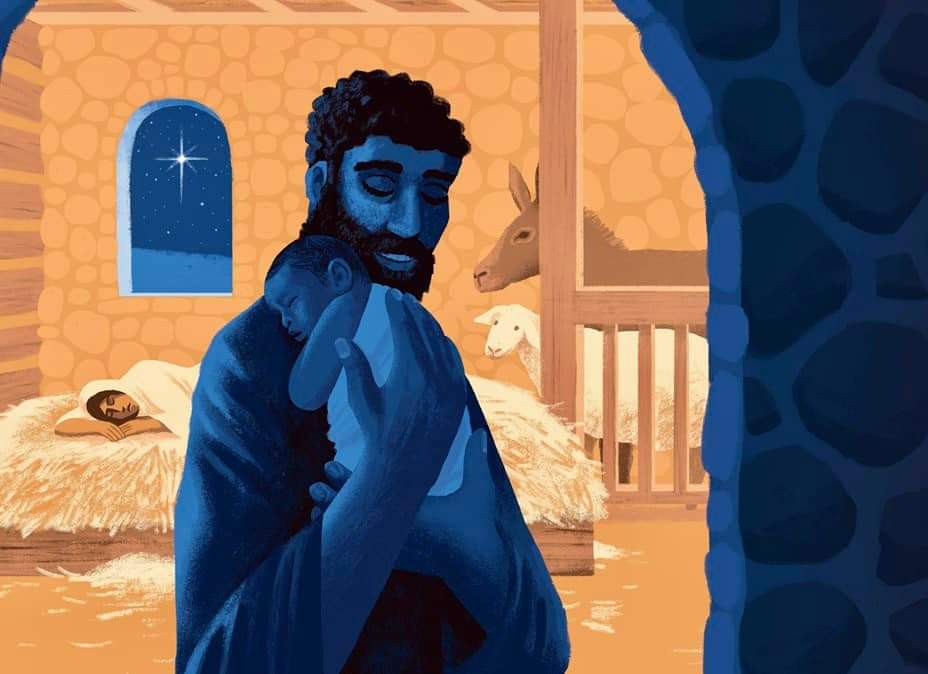
Not a word is spoken by him. He waits, in the shadows. In his dreams, an angel challenges him to find courage to stand with Mary. He remains, faithfully, with her, enduring the questions and snide comments, which will remain.
Joseph’s story begins, shrouded in hesitation. The lineage Matthew offers us has characters hinting at splintered lives and relationships, and some names which have been grafted into the Jewish family tree.
In contrast, Luke’s Gospel offers us two women, courageous and prophetic, embodying hope. Angels are everywhere, in light and triumph, while Mary’s proclamation is unequalled in all the gospel.
Matthew’s offering may well be the one we need in this week. Not only Joseph’s story is shadowed, but possibilities of harm hover all around. The social cost – and risk – borne by these two people, elected by God; the darkness at the centre of which Herod sits, frightened by the possibility of a rival; the new family’s flight into refuge, narrowly avoiding Herod’s mass infanticide.
Those winsome carols about Emmanuel have never been more accurate, despite themselves.
We have been appalled at two terrorists’ attacks on a peaceful Jewish community gathering. Matthew’s story about Jesus’ birth attends to our fears and grief more acutely than tinsel and nostalgia.
The gospel story does not ignore the reality around Jesus, or around us. Jesus is not born despite our world’s woundedness, but because of it. Jesus is delivered under the heel of empire, in a community infected by the corruption of puppet rulers and those enthralled to them.
Jesus and his family are not strangers to violence of the kind we have witnessed in recent days. As we seek to navigate our community’s grief and fear, we name our hope that God is, indeed, with us, and all who suffer.
Our call is not only to assert that hope. We need to articulate it in the face of both calculated and reflexive racism, of political point-scoring, of those taking advantage of suffering and grief and anger.
Hope discovered in Christ is not about a sunny disposition, but a belief that forgiveness, healing and restoration are possible, that God attends to our lives and our world, by becoming like us – fully human, not limited by faith, or politics, or race, or gender. God has acted to save – all of us.
Emmanuel, God is with us. As we find our way to a manger and a tiny child within, we offer a story, with gentle hands and open, obedient hearts; our story is that God is with us, in every circumstance. This is how we will navigate tragedies, like Bondi, like Gaza, like ongoing Aboriginal deaths in custody.
God has moved to be with us, like us, in love. It is here that we begin, again.
When John heard in prison what the Messiah was doing, he sent word by his disciples and said to him, “Are you the one who is to come, or are we to wait for another?” Jesus answered them, “Go and tell John what you hear and see: the blind receive their sight, the lame walk, the lepers are cleansed, the deaf hear, the dead are raised, and the poor have good news brought to them. And blessed is anyone who takes no offense at me.” [Matthew’s Gospel 11.2-6]
On occasions, I have little rituals for how I do things, whether it’s preparing for worship, or starting the mower, or when I am driving my car. I like things in place, and those I love will tell you this is of no inconvenience to them whatsoever, neither is there impatience on my behalf, when the system is disrupted.
Sometimes, people make suggestions how I might alter (improve) these idiosyncratic things. Traditionally, I nod benignly and carry on; in my better moments I address my discomfort, and consider change.
We have prescribed rituals in the life of the church, however, it is frequently the unwritten rules which guide our behaviours as communities of faith. As we journey through Advent and approach Christmas, the cultural rituals – helpful and otherwise – become more pronounced.
There are things we need for “a proper Christmas”, whether it’s the menu, or people we invite, or songs we sing, or stories we tell, or topics which are forbidden at the table. There’s also a sense of how it supposed to feel around this time of year: “It won’t feel like Christmas until the tree is up”.
It’s ironic that a story of profound disruption – teenage pregnancy, demands of empire, risky birth, death threats – we ensure is swaddled in culture and lying in tradition.
What is so scandalous about what Jesus brings? When John sends his disciples to question Jesus, doubts have crept in; being imprisoned can’t have helped. John had an image of what the Messiah was going to bring. It appears that Jesus doesn’t fit.
Consider all the expectations we have of Jesus – and his Church. The indicators of success in the church community are so often seen as numbers in worship, or the amount of money given, or the size of our ministry team. It’s about us.
John is seeking revolution, articulated by a prophet who will lead the march against corruption, injustice and perhaps even empire. From his cell he hears nothing. Is it all wasted?
Our worst moments of fear are that we have wasted our time. That it has all been for nought. All the measurements to which we are accustomed seem to remain unmoved.
Mother & child; Gaza 2025
Then we hear Jesus’ scandalous answers, matching his ministry.
Those who are on the margins, the outcast and the poor, those disabled physically and socially – those who are deemed to be not worth counting – have the good news offered to them, as healing and life.
People are gathered into meaningful community and are restored. The scandal is that those who are marked as worthless are the focus of Jesus’ ministry; a metric of offense, indeed.
This is not what John expected, even intended. So often, neither do we. We had a mission plan: to invite the people like us, who will increase the offerings and populate the pews, and then we will be alright.
Then Jesus leads us to those who have no names and fractured faith, asking us to welcome them, feed them, clothe them, sit with them and, perhaps, advocate for them at some point. And we become them, and they become us.
Change is difficult, especially when it’s culturally embedded. We are easily offended when Jesus doesn’t behave the way in which we expect, then has the temerity to ask us to follow.
At the heart of Christmas is the assertion that God has come for us – all of us. The scandal of this assertion is that God has become like us – every one of us.

 Through A Strained Fence