A Life Less Ordinary

Returning violence for violence multiplies violence, adding deeper darkness to a night already devoid of stars. Darkness cannot drive out darkness; only light can do that. Hate cannot drive out hate; only love can do that.

Perhaps that is how Jesus might have phrased part of his Sermon on the Mount, if he was an African American in the sixties in the United States of America.

“An eye for an eye will leave the whole world blind”, is a phrase attributed to Ghandi and certainly seems to comply with his understanding, both of violence and of the world.
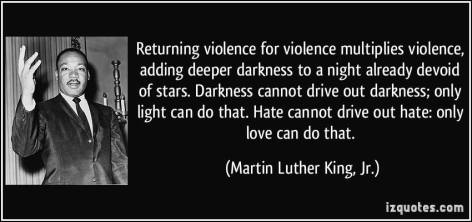
mlk-darknessBoth these men acted within communities and circumstances of violence, as Ghandi sought to establish freedom from the yoke of foreign empire and Dr King sought freedom from the injustice of the empire into which he was born.

When they speak, much of what they say resonates with the words of Jesus, as he implores and challenges his followers to lives which are more. The resonance is not simply the radical wisdom they each offer, but the context in which they offer it. The violence of empire taints the lives of King and Ghandi, and colours the context for every word and action of Jesus.

Retaliation is one thing when you are talking to your children about how to play together, but another when a soldier beats your child for being in their path. The marks of a broken community under the empire’s fist are everywhere: corrupt tax officials taking the jacket off your back and Roman soldiers conscripting your back to carry their goods. Beggars abound, forced by poverty into brazenness and despair.

Jesus calls them, and now us, to more. Walk further with the pack; offer your shirt; be generous, even when it’s hard.

And, by the way, love your enemies and pray for them. Jesus calls us to be extraordinary, because being ordinary means that we end up blind and toothless. Jesus asks us to be perfect, in love and in service, but that is simply too much to ask, is it not?

This is, however, our call. We know the consequences of walking the accepted path – darkness awaits. So we will choose light, the light found in Jesus, who turned his cheek to the violence and lost his clothes to the soldiers and carried his cross as far as he could and loved his enemies at every step – priests and Pilate and Herod and executioners.

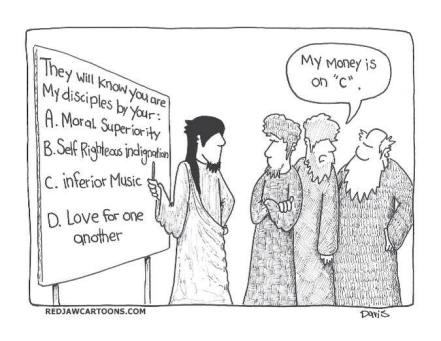
Jesus (and King and Ghandi) hasn’t crafted some maxims with which to inspire contemplation and mindfulness. This is about living an alternative life, as citizens in a God’s empire of justice and hope.  We will travel this journey together, with Jesus’ light, with the Spirit’s song within us, and with each other for company and grace.

The Second Coming | W.B. Yeats

Turning and turning in the widening gyre
The falcon cannot hear the falconer;
Things fall apart; the centre cannot hold;
Mere anarchy is loosed upon the world,
The blood-dimmed tide is loosed, and everywhere
The ceremony of innocence is drowned;
The best lack all conviction, while the worst
Are full of passionate intensity.

Surely some revelation is at hand;
Surely the Second Coming is at hand.
The Second Coming! Hardly are those words out
When a vast image out of Spiritus Mundi
Troubles my sight: somewhere in sands of the desert
A shape with lion body and the head of a man,
A gaze blank and pitiless as the sun,
Is moving its slow thighs, while all about it
Reel shadows of the indignant desert birds.
The darkness drops again; but now I know
That twenty centuries of stony sleep
Were vexed to nightmare by a rocking cradle,
And what rough beast, its hour come round at last,
Slouches towards Bethlehem to be born?

Above & Beyond

I had a rugby coach at school who was fond of saying, “Practice doesn’t make perfect; perfect practice makes perfect.”

He was the kind of coach who asked more of us, in training and on the paddock. It was not sufficient to say we had done passing drills, or tackling practice; had we done it correctly? Were we better as a result? When we played on the weekend, would we be able to replicate what we had trained?

Perhaps the key to his coaching – for all of us schoolkids – was that he had played for the Wallabies, so it was more than theory. He had seen this stuff work.rugby-or-soccer

Many of us remember the teacher, the parent, the mentor, who asked (even demanded) more of us, whether it was at Girl Guides, or in our home, or learning the clarinet. It was often difficult, sometimes unpleasant, but when we found our courage and our way, we saw where we were being encouraged to go.

Our coach required more of us because he saw more in us.

The wonder of Jesus’ Sermon on the Mount begins to fade when Jesus moves from blessing to rigour. Almost everyone we know remembers one, or more, of the blessings, but how many of us willingly remember – and recite – about calling people fools, or the self-imposed discipline of a promise made?

I can honestly say that I have never murdered anyone, and I would expect most of my friends can say the same. But anger and insult? More than that, how often have I deliberately put aside the things which “needed to be done” and found my way back to someone to ask their forgiveness and be reconciled?

My bible’s editors placed a series of headings in this part of Jesus’ sermon, “concerning anger”, “concerning adultery”, “concerning divorce”, as if this is about a series of structured laws, rather than the integrity of our character and the promises we make. Most relationships are wonderful, difficult, fulfilling, awkward and occasionally, boring. How we live together as friends, family, partners and spouses is more than a series of behaviours; it’s our ability to care, serve and forgive – and ask forgiveness – which is the measure of who we are together.

Jesus invites all of his disciples, throughout history, to more. It’s not simply about the power (failure) of a man to cast aside his wife when his gaze is drawn elsewhere, it’s about remembering the coven10488240_10152577377875826_5720551856795683634_nant made of love and commitment – and reconciliation. Much of Jesus’ language in this small section is focused upon men, but we can draw a wider net in which to gather all of us.

It is insufficient to say blandly, “According to the Law, I have not sinned”. Jesus’ fulfilment of that Law calls us to more; to living creatively, to honouring our covenants, to restoring and renewing relationships, to a perfect practice.

This is hard, it requires discipline. We need each other. And we need the hope of God’s promise, the grace of Jesus’ example and the Spirit’s company for each step.

Adding Flavour

It seems like he’s everywhere. When the radio – any station – comes on, or when you flick past any number of websites, or when you don’t move fast enough to change the channel as the news commentary appears on the television.

Donald Trump is ubiquitous.

I have a confident suspicion that he loves it like that, even when the commentary is critical, or the images are poor. “There is only one thing worse than being talked about and that is not being talked about,” Oscar Wilde archly reminds us.

I’m already tired, because it isn’t only since the inauguration, it was the eighteen months beforehand of campaign and criticism and commentary and cheer squads. Mr Trump is on our news more than our news is.

In case you missed it (ironic smile), Christians across the full spectrum of the church have been offering opinions about all aspects of the new President, arguing to and fro, creating a lot of heat and not a lot of light.

As disciples, it’s appropriate to have our judgments informed by our faith in Jesus and to act accordingly. We are, however, called to more than 11069403_1072162782810946_9033090132088524593_ncommentary.

After blessings of last week, for the broken and the heralds in the kingdom of God, Jesus’ calls each of us to more. I have an opinion about many issues in the world, and it’s possible a few of them are even worth considering, but my discipleship asks me how I will act to bring the flavour of God into people’s lives and the light of God’s hope into people’s darkness.

What does the salt and light taste and look like? Jesus spells it out, so that we are without excuse. What can I do, or say, that will help people look towards the God who loves and forgives?

What might I offer someone when they are spewing hatred on the internet, or in the street, which casts hope into the violence in their heart?

What can I say in a conservation which makes peace – creating justice, finding hope, discovering a way forward? When I consider Jesus, I find creative responses to the issues of our lives: live rightly; be reconciled to those around you; value people as more than objects; consider the integrity of the promises you make; r11698607_1118050854890984_8822747988615383105_nestore, endure, embrace. Love.

It’s much easier to type a (clever/witty/acerbic/destructive) response on a Facebook thread than to love your enemy, or to have integrity in your own life. We can be clever and cynical at a barbecue about how badly the world is going.

We are not called to commentary, we’re called to follow Jesus. To whom can you offer forgiveness, or from whom can you seek it? Which enemy might you endure, or even welcome? What stranger might you embrace?

In the face of our fearful, violent age, what hope might we offer in the way we live? We live this way, not despite the world, but because of Jesus.

Taking Notice

I have a deep appreciation of art works where there’s a character at the edge of the picture, or partially obscured by shadow. It’s the character at whom the artist hints, who catches our eye if we look the right way.

I first noticed him (her?) In Rembrandt’s Return of the Prodigal Son, in the left side, towards the back. Some have argued that Rembrandt placed himself in the work, but only just. Others have said it can be each of us, and still others believe we’re overthinking it, and it’s simply one of the witnesses not mentioned in Jesus’ parable. I’m not so sure. Some prints have the character so vaguely defined she barely exists at all.rembrandt-prodigal

I have an image of The Last Supper, by Sieger Köder, opposite me as I write, with a shadowed, shadowy figure, heading for the door as Jesus blesses the wine bearing his own reflection and breaks the bread. Is it Judas? Is it me?

These sorts of unnamed, un-faced characters are deliberately remembered in the gospel, as both Jesus and Paul remind us.

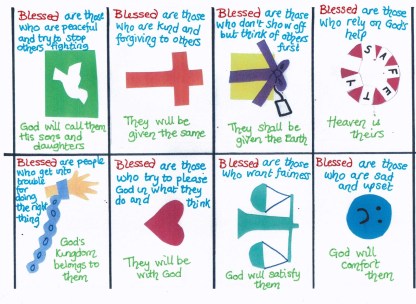
The poor in spirit, the meek, those who weep, the peacemakers, the pure in heart, the merciful, those who seek justice and those who are persecuted and slandered are not only included in the story of Jesus, they are blessed.

Those our community ignores, or discards as inconvenient or troublemakers are blessed!

Those we decry as nothing are everything in the eyes of God.

Paul, rejoicing in the paradox of the cross, amplifies it for us. Wealth, power, wisdom and inheritance are as nothing to the foolishness of God in Jesus.

God chose what is low and despised in the world, things that are not, to reduce to nothing things that are, so that no one might boast in the presence of God.

The “things that are not” are chosen by God. Perhaps Paul’s poetic best? No, this is Paul’s prophetic best, as we discover that those who are told by family, or partner, or parent, or culture, or teacher, or church, that they are nothing, are in fact worthy of God’s everything.beattitudes-cards

Despite our best attempts to ignore them, or paint them out of the picture entirely, in Jesus the unnamed discover  their names, the lost are found.

Our inherent struggle is that the Beatitudes are amongst the most quoted of all Jesus’ words and we live in world which consistently seeks to belie them.

No wonder Paul calls the plan of God madness and a scandal – everything we believe and are told is turned upside down when we name the Crucified One as Lord of history.

We always have a place, and welcome others in our turn. And not just a place, a blessing and a name. Perhaps this wonder is the most profound, God doesn’t just permit, or tolerate our presence, God rejoices and bestows blessing – the ones who are least are already the first in the reign of God.


Christmas Curmudgeon

I have a Christmas confession: I am not a fan of most traditional Christmas carols.

My diagnosis has two parts. First, when working my way through university, I was employed as a Santa Claus (spoiler alert!) each year at a leading retail store in Sydney. Every day for two months, force-fed almost every carol ever written, bolstered by Bing Crosby and the Andrews Sisters singing popular favourites. Even now, White Christmas gives me a light rash.  

The second reason is more important. Many of the carols have beautiful tunes, but a lot of the lyrics paint a picture of the Christmas event as a bit of a Disney movie. Images of snow falling gently, a child who doesn’t cry, and two serene parents managing the whole situation. There’s the directive in one carol “Christian children all must be mild, obedient, good as he”. For me, it’s an extraordinary story we’ve wrapped in cotton wool.

The Christmas story which moves my heart and gives me hope is the one the Gospels tell – miracle and challenge and risk and fear and wonder. A young woman accepting an enormous challenge, risking the shame, in those days, of becoming pregnant outside marriage. A husband-to-be accepting the risk, responsibility and care for his fiancée and her child. A long journey, heavily pregnant, eventually giving birth in a stable, or a cave, or in the middle of a paddock, using a feed box as a cot. Shepherds, unwashed and usually unwelcome, are the first to see the baby, their presence proclaiming that everyone is welcome at the birth.

The presence of God fills the story from the beginning, even when the violence of empire acts, as Herod seeks to kill the child, forcing Mary and Joseph to flee to Egypt as refugees.

This is no Disney story. Our lives have mess, and confusion, and unwelcome guests, and grief and injustice. Our lives also have courage, and risk, and wonder, and people who act generously.

And Jesus is in the midst of it all. The birth of Jesus is astonishing hope, because God is with us in the midst of everything, not insulated from the world around, but present at the heart of it.  God is in it, with us, because God loves us, and gives us all God has – God’s child – to let us know our worth.

This is from a new carol I discovered recently:

Round this birth, as every other,
wars are fought and people flee;
each new mother feeds her baby
with a yearning to be free.
Mary’s song still echoes clear:
justice, hope and peace are near.

baby-jesus-manger

Not Quite What We Imagine

Did you think it would be comfortable? Did you imagine it would be nice? When you listen to a prophet, what did you expect – a gentle pastoral response?

This is the problem with the whole shebang. We imagined it beginning and ending with angels singing triumphantly, a rampant drummer boy and a pristine manger filled with little Jesus-no-crying-he-makes.

Even if we stop reading the Christmas stories in Matthew’s and Luke’s Gospels, leaving out the violence and the prophecies of aged disciples and just stick with the birth, it becomes uncomfortable.

God is at risk in our world, a moment almost as disturbing as it is wondrous.

It’s disturbing, because the moment we engage with the wonder, something happens. We discover that we are being transformed. We find out how valuabno-roomle we are to God, as God becomes human flesh. We discover that we are loved beyond measure and trusted beyond our imagination’s grasp.

And there it is. Because if I am, so are you. If we are, so are they. And any amount of barbed wire wreaths and evasive press releases changes nothing.

John the Baptizer believed that Jesus was coming to “sort people out”, and when there were no reports of revolution and uproar, he sent a message from his prison cell: Are you the real deal?

The response from Jesus is good news: people’s lives are being transformed.

This is where the real discomfort comes for us. We discover not only our own worth, but the worth of everyone. The implications of that are obvious for how we serve and act, for how we forgive and seek justice. But it’s also when we see Jesus declaring this to be the heart of the Gospel – that the least become valued as the most.

John doubted because he expected uproar and instead Jesus brought embrace.  Many of us doubt because we expected it to be more like what we imagined – a wondrous story in which we are embraced and left to live our lives in peace.

When we expect discipleship to fit neatly into our lives, we are wrong. We talk often about the call of God, but we neglect the next part: obedience. All forms of ministry, engaging every disciple, ask us to follow. There are moments when the call dovetails into our life, our community and our family.

And there are the other moments we are asked to leave our home and participate in the call of God in a new way.

What did you expect?accordion-boy

As the story builds of God breaking into the world as a newborn, we need to embrace this story for all the hope and life it brings.

The discipleship of Mary, then Joseph, agreeing to God’s call. The discipleship of John, even as doubts begin. The declaration of God – how much all humanity is valued and loved.

God entrusts us with his child, vulnerable at the heart of the creation. God entrusts us with his story, offered with the hope with which we discovered it.

As these weeks draw close, let us ready ourselves for the surprise of God in our world – again.

When You Let Your Cousin Preach

So, it’s the new minister’s first sermon. People have worn their best church clothes, and there are a few new hats being spotted around the Congregation. The new minister steps to the pulpit, dressed in an unusual and informal outfit, looking like she’s had one too many espressos before worship.

People do the church-what-on-earth-sidewards-glance-towards-each-other-then-the-door-mild-panic-thing. And she starts

You brood of vipers! Who warned you to flee from the wrath to come? Bear fruit worthy of repentance. Do not presume to say to yourselves, ‘We have Abraham as our ancestor’; for I tell you, God is able from these stones to raise up children to Abraham. Even now the ax is lying at the root of the trees; every tree therefore that does not bear good fruit is cut down and thrown into the fire.

Mobiles (set, of course, to silent) are activated as people send frantic texts to each other and to the powers that be. What’s going on?

This is not the language and style – thankfully – that we usually hear in worship. But in eschewing the violent imagery, have we neglected the challenge?church in box.jpg

John the Baptist confronts those who have become complacent about their faith and their world, who have become complicit in the injustices and the broken system which pretends to govern.

John’s language is compelling; it’s Advent language. If you’re readying yourselves for the coming of Christ, what does that look like? Buying gifts for those you love? Decorating your favourite tree? Another Christmas party?

If these questions discomfort us, perhaps they should. Just as we smooth the rough-hewn cross to a comfortable veneer, and sterilise the stable so that the cattle could feed in our lounge room, we take the belligerent language of John and dismiss him as Jesus’ angry cousin.

That’s not good enough. In fact, it’s wrong.

The life we have been offered in Jesus Christ calls us to offer that life to others. But the story is not crafted in fear of what God will do, it’s crafted in hope because of what God has done.

A child in a manger, God as one of us, tells us the incredible value of each human being; God has become exactly like one of us, born as one of us. The extraordinary becomes normal and thus, the normal has become extraordinary.

What does this say for how we treat our neighbour, our enemy, our refugee, our politician, our sister in Aleppo and our brother on Nauru?

John tells the crowd there is nowhere to hide from the call of God; showing our church membership, or claiming our place in eternal life is an exercise in deception if we fail to turn our lives towards Christ.

As we ready ourselves for the joy of Christmas, how shall we serve others, how shall we act justly and how shall we honour the image of Christ found in manger, cross, resurrection – and our neighbour?


Remembering Hope

advent-sime-leeWe are entering the season of hope and the signs are all around us: jacarandas (and Patterson’s curse) are incandescent and cereal crops are ready in the paddock – reflections of good, plentiful rain. There are flies everywhere, too; reminders of the season, but certainly not blessings.

It’s only a handful of Sundays until we remember one of the stories at our faith’s heart. We begin with portents of hope – Israel restored, with swords and spears used instead to prepare, then harvest the crop. The hope is well-founded, our wait is not in vain; this coming story of babies and mangers is not just one of profound beauty, but the earthed story of our God fully present in our broken world.

Israel waits, the first disciples waited, as we wait, for this to be complete.

We light a new candle each week, and we wait.

We remember, and we hope, because we remember what God has sung in Jesus Christ. Our waiting is the singing of that song; our waiting is forgiving those who need that word spoken; our waiting is loving our neighbour, and then our enemy, despite the struggle of each heartbeat.

Our waiting is creating peace where there is none, and declaring our hope when it seems reasonable to despair.  Our waiting is joining the Spirit’s chorus, crying out for justice, feeding the hungry and healing the broken-hearted.

We wait, as citizens of the kingdom which is to come and is already here.

We wait, because we remember, and we hope.

This hope helps us to remember that Caesar’s commands and Herod’s depredations and soldiers’ violence and a baby’s vulnerability and parents’ humanity cannot define, restrict, or defy the Word of God spoken into the world.

At our weakest, we believe it’s entirely up to us; at our worst, we proclaim that Caesar really is Lord.

Why is why we are called to remember  so faithfully, and why we are reminded to wait so deliberately. It is why we need each other to remind us when we stumble.

We are disciples of Emmanuel, of Jesus. We are apprenticed to him, and each deliberate act of hope is found first in him. These are the jacaranda flowers of our lives – signs that God is both coming to us, and is already with us.

We are never called to save the world, but we are called to live in the hope of the one who has – Jesus Christ.jacaranda-grafton

Finding Hope

The news is unrelenting, compelling. The final throes of the presidential election in the United States are being played out and the improbable – indeed what some believed, impossible – has happened. I will leave it to more able and seasoned commentators to ask the why and wherefores of electing Donald Trump and not electing Hillary Clinton.

I want to ask about hope.

It seems that, for many who chose to vote for Mr Trump, hope was a motivator. People hope their lives will change, that their lot will improve. Some hope that their country will find a new direction, or perhaps return to what they believe their country looked like before. Before President Obama, or the Presidents Bush, before the Iraq and Afghanistan Wars, before the Twin Towers, before globalisation, or just simply, intangibly, before.

For many, life has become increasingly hard, and the changes with which they are confronted have become remorseless. It is these people who have found no sense of hope with what they perceive as “the system”, so they have turned elsewhere, leaving a fractured system in their wake. Systems are, by their nature, dispassionate, whether they are markets, or computers, or flow charts.

The people who believe they are ignored, or rejected, have chosen someone they hope will attend to them. Those who believe they are regularly placed last have elected someone they hope will place them better than last.

It is too easy – and false – to typecast these many millions of people as uneducated, or racist, or wrong. The temple erected for them by the system, of trade liberalisation and market worship, has proved an empty shell for many who were told to believe. Is it a coincidence that Jesus prohope-nearphesies the fall of the temple immediately after an impoverished widow puts her last coins in the temple coffers?

Hope is realised when people know they have value – and any system will fail them there. The best sermon means nothing if the preacher has no integrity – integrating words spoken and life lived. Anyone who claims to offer hope by blaming others, by scapegoating or punishing, is not offering hope, but hatred.

The temple is not worthy of your faith. You’ll find no hope in a building, you’ll find it in God’s act in Jesus Christ. Jesus did not simply notice wounds, he healed them. He did not simply name the lost, he embraced them. Jesus did not simply identify the broken, he identified as one of them, and in so doing, saved us all.

On this day, when I don’t understand how this result can have happened, I place my hope in the one who invests everything in the whole creation – to give life.

This I believe, and therefore I have hope:
the steadfast love of the Lord never ceases,
his mercies never come to an end.