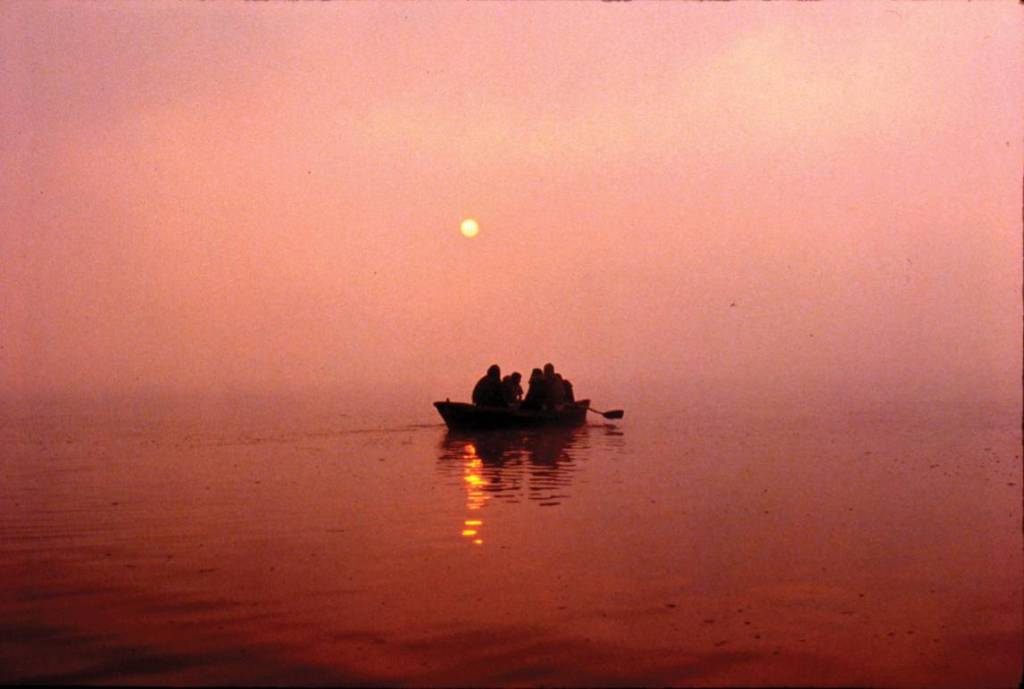
The Companion | Kevin Hart

There is a man who will not let me sleep,
each night he comes and trembles by my side;
he cannot be touched yet wind disturbs his hair,
he cannot touch yet his shadow covers me.

Each night he comes and trembles by my side,
I reach towards him and he fades like day.
He cannot touch yet his shadow covers me,
I hide within myself and he draws close.

I reach towards him and he fades likes day,
I hear him though he does not speak a word.
I hide within myself and he draws close
and stretches out both arms as if in pain.

I hear him though he does not speak a word,
the sound of something breathing, wind in the trees.
He stretches out both arms as if in pain,
‘I come to wound you and to heal the wound’.

Behold, Your King

As [Jesus] was now approaching the path down from the Mount of Olives, the whole multitude of the disciples began to praise God joyfully … saying,
“Blessed is the king who comes in the name of the Lord!
Peace in heaven, and glory in the highest heaven!”
Some of the Pharisees in the crowd said to him, “Teacher, order your disciples to stop.” He answered, “I tell you, if these were silent, the stones would shout out.”

[Luke’s Gospel 19.37-40]

“Let me tell you about a king,” says Jesus, inviting all who listened to hear a story all of us know. The wrong kind of monarch, who lived and ruled by a hunger for control of people’s lives through slavery, hatred, fear and a monstrous brutality.

Those desperate among us want to find an echo of God in Jesus’ parable, rather than discovering something else. We confuse this with the other parables of talents and gifts; however, this is a story of a dealer and despot and a few who are temporarily lifted, while others are forever crushed by his arbitrary gestures.

Why does Jesus tell this story, and why does Luke remind us?

One sentence later, Jesus has arranged transport and is riding into Jerusalem, facing not just the adulation of his disciples and the crowd around him, but the resentment of the Pharisees.

These will be the final days of his life.

Crowd-crowned and mounted on a donkey, this monarch for whom the stones themselves would sing has no intention of sacrificing anyone but himself.

The initial hallmarks of his reign? Weeping over his city’s failure to seek and understand what makes for peace, and restoring the essential place of worship to teaching and prayer.

Could there be a starker contrast between the grotesque Ozymandian character whose tale Jesus told, and himself, who, like the widow he praises, offers all he has?

When a child asks, perhaps, for the story of a monarch, shall we talk of swords and crowns and rings? Shall we speak of the weak ridiculed, and the poor discounted, of smaller nations trampled and their leaders despised and mocked, with slavish adulation offered to those whose trademark is corruption?

The language of queens and kings may have less currency in these days (and that is good) but the language of God’s kingdom – God’s reign, God’s economy – stands as prophetic corrective to all those who rule by diktat and despair.

This Jesus who arrives in Jerusalem, travels deliberately to his suffering and death, while his path has offered healing and forgiveness, mercy and hope. These last few days will remind us of transformed lives and communities, and the possibility of life renewed for all of us.

As the shadow continues to fall, and Friday is but days away, two thousand years is but a moment as we measure Jesus’ monarchy against all those who rule, or seek to do so, in the world around us.

We will walk Jesus’ path with him, from the temple to the cross. We will see the astonishing truth of Jesus’ monarchy and find ourselves embraced within it. On Sunday morning the very stone which sealed his tomb will sing aloud of the One whose life is entirely given for others.

Blessings for this week’s journey.

Palm Sunday | Malcolm Guite

Now to the gate of my Jerusalem,
The seething holy city of my heart,
The saviour comes. But will I welcome him?
Oh crowds of easy feelings make a start;
They raise their hands, get caught up in the singing,
And think the battle won. Too soon they’ll find
The challenge, the reversal he is bringing
Changes their tune. I know what lies behind
The surface flourish that so quickly fades;
Self-interest, and fearful guardedness,
The hardness of the heart, its barricades,
And at the core, the dreadful emptiness
Of a perverted temple. Jesus  come
Break my resistance and make me your home.

Easter & Our Community

This piece was originally written for the Nyngan Weekly.

There is palpable relief across much of the western areas of our state as we head into Easter. The hot dry spell has eased, and many are thankful for good rain, which signals hope for the season ahead. Pressure has eased for the moment.

In the next breath, we are conscious of those who are confronted by the calamity in western Queensland – stock death and damage are considerable, and the extent will not be properly revealed for some time. Stories of this nature are not unknown to our communities, and we will offer what we can to those north of us.

This is the challenge of living where we are, and addressing the realities before us. We all know this, and look for signs of encouragement and hope where we can.

As I walk into shops in my community and see cheese and vegemite hot cross buns, and fluffy bunnies (occasionally stuffed with chocolate), I don’t understand how these ideas of Easter make any sense, or address the world in which we live. Are they meant to distract us from the world around? Are they simply meant to be enjoyable? (I am not confident that those particular hot cross buns would even be edible!)

Easter is not only about celebration and wonder. At the crux of the Easter message to which I respond most completely is the affirmation that God is with us, always.

This is not a message to entertain or distract us, but addresses the essential moments of our lives, and the lives in the world around us.

At the beginning of Easter week, the story of Jesus leads us towards the cross, towards Jesus’ death. Good Friday is the punctuation of this journey, as the Roman Empire, corrupt politicians, broken religious leadership and an easily swayed crowd decide that executing Jesus will help them. This is a story which we can see in the world right now – how when things break down, corruption seeps in and people suffer.

Jesus’ death is the assertion that God is with us in the broken moments, when injustice happens, when the world goes entirely pear-shaped. When we suffer, as individuals, or families, or communities, we are not alone in our suffering; Jesus has experienced brokenness and injustice. And death.

On the cross, God is most completely with us.

On Saturday, after Jesus has died, we wait; all creation holds its breath. We hope that this is not the end of the story. Waiting is not uncommon for us; we wait for our lives to recover from disaster, for the news after an operation, for a relationship to be restored after a fracture.

And then, Easter! When the impossible happens, and life breaks out. Jesus’ return to life is the new assertion of God, that death is not the strongest word, that love and life are stronger than punishment and injustice, that suffering will have an end.  

As we mark this Easter journey and eat our (traditional) hot cross buns, may I encourage you to consider the hope of God who is with us, always; in the good seasons, and the ones we would never choose.

The God we know in Jesus is about love, hope and forgiveness, and being with us in every step, leading us to life.

Enjoy your Easter!

When Actions Sing

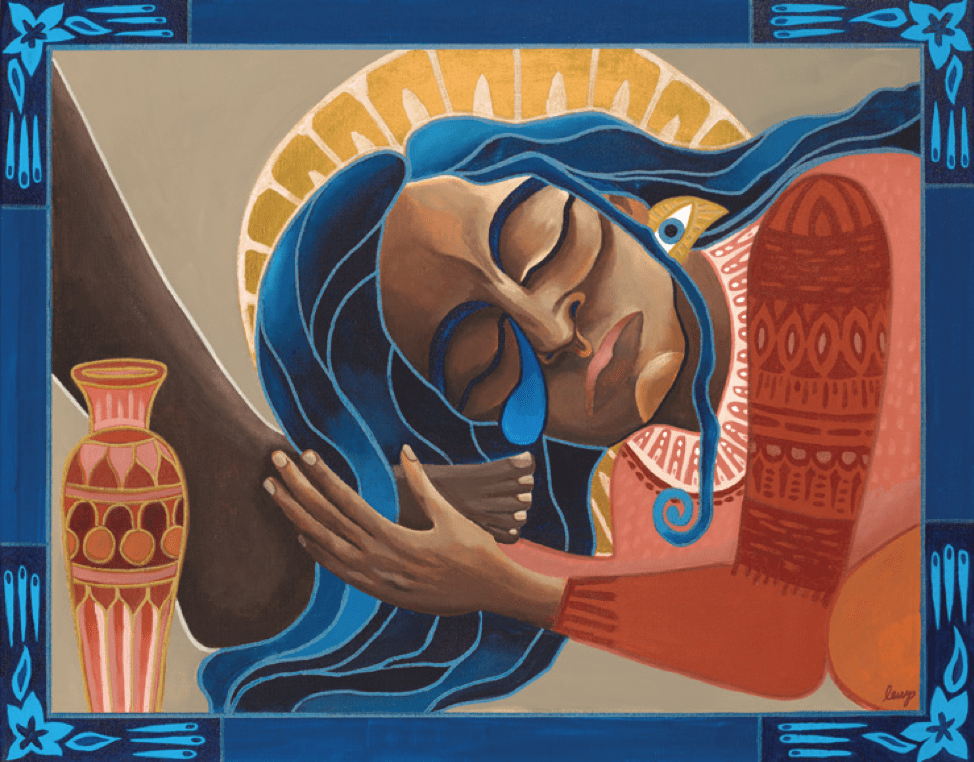
[At Bethany] they gave a dinner for him. Martha served, and Lazarus was one of those at the table with him. Mary took a pound of costly perfume made of pure nard, anointed Jesus’ feet, and wiped them with her hair. The house was filled with the fragrance of the perfume. [John’s Gospel 12.2-3]

She is silent.

In each version of this story told, in every gospel, she says not a word.

In spite of all the stones hurled at her, of anger, injustice, labelling and accusation, even when she is embraced by the mercy of Jesus, not a word passes her lips.

Yet in her silence, her actions sing.

Despite being nameless in three of the four gospel stories, and labelled “sinful” when Luke tells the story, few are better known, and even fewer stories are retold so often and held with such care. Perfume, tears, embrace and anointing are the hallmarks of her love.

Mark and Matthew recall Jesus’ words, that “wherever the gospel is proclaimed in the whole world, what she has done will be told in remembrance of her.”

So many of these women whose presence, whose ministry, is so frequently offered in silence and conducted in anonymity, proclaim in their response and their actions the reign of God.

A woman takes two small copper coins, worth virtually nothing, and almost everything, leaving those who watch in no doubt as to both her faithfulness, and the demands of the temple on those who can least afford them. Another woman, silenced by illness and social isolation, urges her way through the crowd to find not only healing at her touching of Jesus, but the embrace of his affirmation.

These women, and others, by their faithfulness and courage, urge us to a more complete discipleship. Mary, clearly identified as one of Jesus’ disciples, by her attention to his word as she sits at Jesus’ feet, and by her affirmation of faith, offered only a heartbeat after her brother’s death, offers now a sacrament of anointing.

No word is needed. Such extravagance, such generosity. Measured not by dollars and cents and bookkeepers, but by the perfume which fills the house.

This prophetic word which Mary tells soundlessly, by expending so much of herself in one moment. This wondrously wasteful, intimate act, acknowledging that suffering and death stand at the door, waiting for Jesus.

This song she sings, knowing that she will not have Jesus with her for much longer, urging us to understand.

What is it for us to be so generous, when we have been so consciously taught to be careful, even frugal? What will it mean for us to be wasteful in such a way as Mary, to be as courageous as she is, and those other unnamed women who find their way to Jesus and to justice, to hope and healing?

What will it mean, indeed, for us to not only find our own way to Jesus, but to open the way for the nameless others who have been told, consistently, there is no path, no healing and no place?

Mary sings it for us, always.

Note to Self on Bad Days | Nikita Gill

I will not give in to apathy
I will not swallow hopelessness
I will not bow down to despair
Every ancient tree has to fight storms
before it becomes a forest.
Every old bird has to learn survival in a nest
before it can learn the magic of flight.
I am learning from them
what it takes to live.
I am learning from them
how to hold on despite the odds.

– Nikita Gill 2025

Changed, Changed Utterly.

So if anyone is in Christ, there is a new creation: everything old has passed away; see, everything has become new! [Paul’s Second Corinthian Letter, 5.17]

Is it the embrace? That moment when the failed, recreant child returns home, after wasting life and money and trust in a far country? Is it then?

Or perhaps when the faithful older child realises he has neglected to understand the love and mercy in which he has lived every moment of his life?

That moment when everything changes.

In one of Jesus’ best-loved parables, a child rips their portion of their father’s bequest from his hands and heads into a season of waste and dissipation. The disaster occurs, as every original hearer expects; he ends up hankering for the pigs’ food as he hands it to them, so profoundly has he fallen.

Eventually, he sees himself as every listener does, a deserved failure. He finds his way back to his father, expecting servitude, hoping for bread. He does not make it completely home, because his father runs to him, interrupts his repentance with compassion and embrace. The child discovers not servitude but celebration, not bread but feasting, not begrudging tolerance but love.

Is everything changed then?

He, too, has resigned his part
In the casual comedy;
He, too, has been changed in his turn,
Transformed utterly:
A terrible beauty is born.

And then, this elder child, this faithful one who worked and served and has not once asked for anything. Never asked, never expected that every morsel, every song, every blessing, was his for the rejoicing.

Too long a sacrifice
Can make a stone of the heart.
O when may it suffice?

Compassion is offered with an embrace and kisses to the younger child, and the older one discovers he has been embraced in love for each heartbeat of his life.

Paul tells us that when someone discovers themselves in Christ, everything shifts, all changes; there is a new creation. It is not simply acceptance, or acquiescence; it is the miracle of one who finds themselves loved, forgiven and alive.

It does not suffice for just the one who finds life, but all around are changed. We see the possibilities of what it means to be forgiven, to be restored, and we hanker for it, even as we find it hard to understand.

This is for all, the faithful and the failures. This is food for all who hunger, nourishing and splendid. This is for all who believe themselves beyond hope, beyond mercy, beyond return.

This is the declaration of a God who, through Jesus Christ, embraces us, forgives us and welcomes us all home.

The verses quoted are from W.B. Yeats poem, “Easter, 1916”.

Lost & Found

Walking in the bush is a wonderful experience. Fiona and I try to take a three or four day walk each year in a National Park. We are not always successful.

One aspect of the wonder is not always being particularly confident that I am in the right spot or heading in the appropriate direction. I have read books about being lost and confused in the desert, where each rise looks precisely like the previous one, and nothing seems different, or appears to change.

Standing in the midst of the Australian bush can be confounding for the entirely opposite reason. It’s full – of trees, which are reliably irregular in size and shape; of low scrub, so footprints are obscured as if you have never walked to where you are; and it’s dense, so that seeing the path (if there is one, in particular), or the goal of your walk is frequently unclear.

The sounds can also be disorienting. Cicadas in summer can be stunningly loud, sounding triumphant, even mocking, if you are confused. Frogs take their harmonic turns through the evening.

The raucous choral wonder of birds is operatic, if you know your path; if you aren’t sure, or have missed your turn, they can taunt you at every step.   

A map, and a compass, a GPS (if you have range) and an EPIRB (as a last resort) are either essential or preferable in your walking, moving from a model of orientation which has served us for centuries, to one which many of us still don’t completely trust.

I have European friends who regard the disorder of our native forests as chaotic, even threatening. The concern of becoming lost looms large for them, as it has for those of us who have settled in this land since the last decade of the eighteenth century.

Becoming lost is a fear many second Australians share. A book, The Country of Lost Children – An Australian Anxiety, by Peter Pierce, describes how art and story depict the deep concern of what lies in the scrub, the bush, the area beyond our fence. McCubbin’s artwork, stories like Dot and the Kangaroo, serious movies like Wake in Fright and One Night, The Moon all echo the fear of being lost in the Australian landscape.

Gaza, West Bank 2025

That fear translates into many aspects of our world; in the increasing urgency of life around us; harried by the insistence of electronic communication; the constant need to learn new skills; all these lead to a feeling of disorientation and lostness.

We are often unsure that we know where the path leads, or even how we arrived where we are. We remember the safety of home, of the spaces we know. We are thankful for a familiar friend, our favourite chair.

This season in which we find ourselves now, this season walking towards Jerusalem and the cross, with Jesus, can be disorienting. The concept of Jesus’ suffering and sacrifice might be well known to us, but the journey for disciples – especially the original mob – takes them (us!) from familiar territory into apparent danger.

We know the story of Easter from the other side. We have seen not only Jesus’ death; we also know of his resurrection. We journey with this hope already in our lives.

One theologian uses the Prodigal Son parable as a starting image, and describes Jesus as the son who journeys into a far country, risking himself, to find us all in our lostness and bring us home.

What might we say of a God who persists in seeking us out and, in Jesus Christ, finds us? We have this traditional image of the Aboriginal tracker, who can read the signs no one else can identify, finds the lost child and brings them back to their family and community.

Our language of “finding Jesus” is, perhaps, a subversion of the truth. The one who seeks is God, in mercy and love, who insists on finding us and bringing us safe home. When we encounter  – and are embraced by – this God, we most certainly discover our one true refuge.

This piece was first written for Ruminations, the rural journal of Saltbush – Uniting the Scattered Community, a ministry of the Uniting Church in NSW & the ACT for rural and regional communities.

#Saltbush
https://saltbushcommunity.uca.org.au

Giving A Fig

He replied, ‘Sir, let [the fig tree] alone for one more year, until I dig around it and put manure on it. If it bears fruit next year, well and good; but if not, you can cut it down.’ [Luke’s Gospel 13.8-9]

“I have things to do, of value and service. I can’t be worried about when it’s going to happen.”

I was speaking to a splendid friend and colleague recently, who talked about the challenge of a health issue which hovers around their life. The consequences of this particular health issue are terminal, and the choice might well be to shut down, to live a life of complaint or fear, or to renew your mind, as my friend has, and to step into the world as it is. “I have service to offer others. I am not simply going to sit around and wait.”

Jesus’ recent conversations have been about how we read the signs of these times and live faithfully within them. He is confronted suddenly with the punitive and abhorrent actions of the provincial Governor.

Perhaps someone is being punished? Perhaps a deity is having a bad day? There has to be a reason.

Jesus’ cryptic response reminds us that injustices and accidents occur constantly; how will we live in this season, when death and acts of violence are consistently before us? We have plenty of teaching from Jesus about forgiveness and non-violence, and living hopefully and faithfully.

And accidents happen, friends become ill – this has always been true. People suffer and grieve. If we say this too fast, it will sound glib and uncaring, but if we say it with the attention it deserves, we realise that we are living here, and we need to attend to those around us, offering care and hope, and mercy.  

Jesus invites us to be prepared, within ourselves. The word for repent here is “to change one’s mind”; it’s about renewing how we think about, indeed how we understand, our world and our lives. It’s about comprehending that faithfulness involves laying failures and brokenness aside and taking up the life to which Jesus calls us.

How long will Jesus wait? How long will the faithful gardener tend the tree? Has the owner of the vineyard come down and complained before?

A theologian comments that God’s mercy remains in serious conversation with God’s judgment. We are urged to live our lives more faithfully, to turn from the failures – deliberate and otherwise – which hinder our relationships and drag our feet.

We cannot read these stories too lightly, or mathematically. Jesus is addressing suffering and death, and where real life – and hope – are found. This is not about balancing scales, or solving a life equation.

Jesus in on the road to his own, unjust, death. We have no measure for an act of such mercy, or hope.

In a world where vast injustice is enacted each day, where accidents occur despite our best efforts, we follow one who chose suffering and execution, in order that death would never again be the final word spoken.

Our story is held in the nail-scarred hands of Christ. God intends, in Jesus Christ, to save. What can we imagine will hinder God’s intent?

April Fool | Peter Steele

Done with Herod and the glittering robe,
the zinfandel in Pilate’s bowl,
the scarlet thorned together at his breast,
he went, what was left of him, after
the lashed bone and lead toggles were finished
making completely clear who
was who and what was what, out of the city,
a day’s work still to do.

A retrospective piety would have him
gaze down the novel vistas
of Flodden Field, Antietam, Gallipoli
the flaming butter of napalm, the gulf
made in the air when atoms boil, the hiss
of gas to deal with other Jews:
but he may have found it saving grace enough
not to be hating bloody fools.