Beyond Words

“What do you think? A man had two sons; he went to the first and said, ‘Son, go and work in the vineyard today.’  He answered, ‘I will not’; but later he changed his mind and went.  The father went to the second and said the same; and he answered, ‘I go, sir’; but he did not go.  Which of the two did the will of his father?” They said, “The first.” Jesus said to them, “Truly I tell you, the tax collectors and the prostitutes are going into the kingdom of God ahead of you. For John came to you in the way of righteousness and you did not believe him, but the tax collectors and the prostitutes believed him; and even after you saw it, you did not change your minds and believe him.” Matthew’s Gospel 21:28-32

It can be unsettling to read Jesus’ words, the stories he tells us. If we place ourselves honestly in the crowd he is addressing, we can find ourselves standing somewhat awkwardly.

When we celebrate communion, speaking about hunger and thirst, very few people I have served come suffering from lack of food. Most come well fed and watered, sharing in the benefits of our community’s prosperity. I would assert that almost no one has come unfed, or starving. If they did, is there enough for them, to feed them? Would we sacrifice our own piece of bead, our share of wine, that they might be satisfied?

We talk about sacrifice, even poverty. In the western church, we have spiritualised these to a considerable extent, because most people we know have enough for their daily bread and more.

Is this the appropriate time to mention the astringency of most communion meals – tiny cubes of bread, tasteless wafers, and thimbles of juice, or minimal sips from a chalice? What metaphor resides here for those who hunger and thirst?
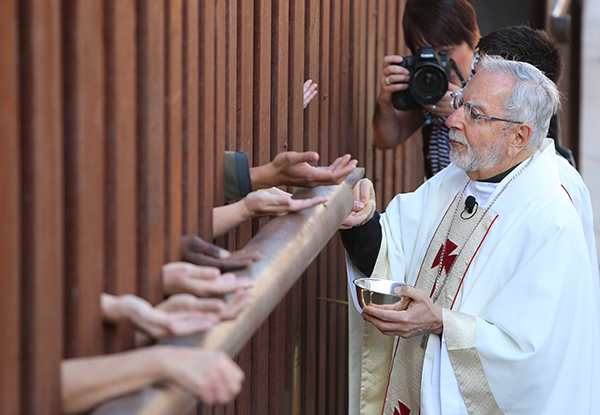
Cardinal Seán O’Malley of Boston and 7 other bishops celebrate Mass on the US-Mexico border in Arizona to commemorate the deaths of migrants in the desert and to pray for immigration reform on April 1, 2014.

Jesus has just ripped through the temple; his anger (as always) is because those who most need it have been prevented from finding life – food, healing and forgiveness.

When people have lived broken lives, the offer of healing, of hope, is considerably more than a sermon theme. When we reduce sin, micro-managing it into “sins”, measuring out our lives in instances of misbehaviour, or naughty thoughts, we diminish the real impact of sin on our world, on those around us and on our own lives.

When women and their children live under the violence of coercive control, what can a community of faith offer which will serve and, even offer safety to, them? When a person in addiction believes they deserve their own suffering, what might we give to them, which offers life, not judgment?

The missionary D.T. Niles is quoted as saying that evangelism is just one beggar telling another beggar where to find food. What is food, for those who are starving?

Do not misunderstand me. Everyone needs nourishment in their lives.

Jesus reminds us that those who are hungry know food when they tase it. Not when they read the menu, or see it on a website.

Matthew’s Gospel leads us through Jesus’ consistent reminders that we are called to act, that our words or protestations of faith have far less merit than the acts which serve, advocate for, and protect. One son proclaims obedience; one son articulates it with his life.

Service is the tangible practice of our faith; this is where we are called by Jesus Christ.
Creative Disruption

…the owner of the vineyard said to his manager, ‘Call the labourers and give them their pay, beginning with the last and then going to the first.’ When those hired about five o’clock came, each of them received the usual daily wage. Now when the first came, they thought they would receive more; but each of them also received the usual daily wage. And when they received it, they grumbled against the landowner … But he replied to one of them, ‘Friend, I am doing you no wrong; did you not agree with me for the usual daily wage? … Am I not allowed to do what I choose with what belongs to me? Or are you envious because I am generous?’ So the last will be first, and the first will be last.” [Matthew’s Gospel 20:1-16]

This is one of the passages in which a really energised argument can commence. I have sat in a group after this parable was read, where one person grumbled about “bloody socialists”, while another countered with a comment about capitalists underpaying people and sparking injustice.

So, here we are, with another of Jesus’ disruptive parables. Is it, as economists like to call it, creative disruption, or is it something else? Wikipedia defines creative disruption as “a radical change in a marketplace brought about by the overturning of existing conventions”. Once again, Jesus.

Jesus, with the stories of badly-behaved sons and better-behaved Samaritans, with tales of tax collectors and pharisees, and slaves being forgiven debts of a bazillion dollars.

How do we respond when Jesus offends our sensibilities? Traditionally, many within the church spend considerable time and energy seeking to ameliorate the stories, diluting the language and airbrushing the rough images.

In the case of this parable, throwing in our lot with the socialists, or the capitalists would be to miss the comprehensive challenge of engaging in the economy into which Jesus invites us. This is much more than an argument about the social daily wage, or the measure of labour done. There are elements which can be explained, or perhaps even explained away, which only provides a disservice to the provocation Jesus offers us.

What if the reign of God – the economy of God – invites, serves and eventually redeems each and all of us? What if those who arrive in the last minute are rewarded as completely as those who have been present for the entire day? What if the measures of God’s economy are the mercy and life offered in Jesus, and not the pay scales of the world in which we live?  

We can feel disgruntled at this moment; we have worked hard for most of the day, faithfully and well. They have appeared at the last moment, or after us, at least, and they are rewarded equally?

In the current fraught political conversation about immigration, a whole new meaning is given to “those who arrive later than us”. The definition of fairness has become bastardised by punishment and self-interest, leaving us in a context of shouting and accusation. The spoils from this go only to the punishers.

Jesus measures out our lives and value by the generosity of God, not by hours worked, or arbitration. This generosity, this grace, is both unceasing and beyond measure. This assurance is held, not in our own hands, but in the nail-scarred hands of Christ. Thus, we are able to offer this hospitality in our turn, disrupting and creating as God has done for us.

A Bazillion Dollars

Then Peter came and said to him, “Lord, if another member of the church sins against me, how often should I forgive? As many as seven times?” Jesus said to him, “Not seven times, but, I tell you, seventy-seven times. [Matthew’s Gospel 18:21-22]

It depends on your frame of mind, on the background you have, on the context in which you have lived, and live now. This shapes how you hear something and, thus, how you respond.

Is this a series about matters of compliance from Jesus, about the requirements of forgiveness and the consequences of disobedience, or is it something else?

Jesus’ compelling parable which follows this saying, – about the phenomenon of forgiveness, and the risk of withholding it – causes ripples all around.

The extraordinary character of Jesus, elevating children several times as exemplars of faith and discipleship is confounding for those who hear it first, and for many who follow in later generations. The story of a shepherd who will leave ninety-nine sheep to search for one hapless wether (probably the same sheep as last time) is an astonishing indication of the context in which these stories are first being told.

What if we read these stanzas from Jesus as some of the ways in which community can be grown, as an astonishing alternative to the world of self-interest and self-justification which thrived then and has never paused?

When Jesus spoke last week about meeting with one who has “sinned against us”, this was not primarily about confronting an aggressor, but about restoring relationship, and, thus, community. This is discipleship, not compliance, or a measure of punishment. 

This rabbi is steeped in the Jewish understanding that people can change, can be forgiven, and can be restored.  The unexpected moment is when Jesus exponentially moves the tradition of accountability being sought and forgiveness offered to seventy-seven instances – a slave’s immeasurable debt of a bazillion dollars being forgiven.

As always, in response to the generosity of God, we consider what we do with the gifts offered to us. We can hold them as property, avaricious for our own advancement and security. After a moment, gift becomes possession, and its value diminishes, alongside our discipleship. Eventually (and sooner than imagined), this experience of God’s mercy becomes only nostalgia, a shrunken trinket over which we reminisce.

The gift of God is for giving. It fs for offering to those we love, to our neighbour – and to our enemies.

We can become misdirected in the parable, looking at the monarch’s final punishment of the slave. The heart of the story is the monarch’s exceptional generosity, which the slave entirely – even wilfully – misunderstands.

Forgiveness is neither a game, nor a transaction, where one person holds power over another. It must never be whimsically considered, because harm caused can be crippling, as we have seen with domestic abuse, coercive control amongst our friends and family and, on the world stage, in the long enmity and violence of nations.

We are consistently offered the gift of forgiveness in Jesus Christ. When we receive this gift, we are responsible to offer it in turn. Sometimes this will be too hard for us to accomplish alone; we will need the company of those we trust, and the compassion of God’s Spirit to step this path out.

This has always arisen from the compassion of Christ. The wonder of being restored magnifies our hope for others’ renewal. It is this hope which upholds, enables and confirms us as we seek to be reconciled to those around us and to the world for which Christ died.

Wendell Berry | Poet, Farmer, Ecologist, Theologian

[Jesus said] Truly I tell you, whatever you bind on earth will be bound in heaven, and whatever you loose on earth will be loosed in heaven.  Again, truly I tell you, if two of you agree on earth about anything you ask, it will be done for you by my Father in heaven.  For where two or three are gathered in my name, I am there among them.”    [Matthew’s Gospel 18:18-20]

Wendell Berry died this week, in his early nineties, after a life of  reflection, adventure, farming, theology, poetry and engagement in the beauty of the creation of which he was an avid part. 

His poem, The Peace of Wild Things appears regularly on social media pages, and in the Christian environmental pages. Berry writes beautifully, with patience and attention to detail – in the world around him, in his relationships.

The poem below speaks for itself.

It seems appropriate for the readings we have been walking through in these weeks; in Paul’s Roman letter about how the gift of the Spirit enables us to bear witness to (even to bless!) those seek our harm; in Matthew’s Gospel we are confronted as Jesus speaks about the demands of community and discipleship.

This week  Jesus speaks about shaping community around relationships and reconciliation, being honest and facing difficult issues and people In next week’s gospel reading, Jesus will answer Peter’s enquiry about the budget of forgiveness and blow his bottom line, completely.

May Wendell Berry rest in peace and rise again in glory.

To My Mother |  Wendell Berry

I was your rebellious son,
do you remember? Sometimes
I wonder if you do remember,
so complete has your forgiveness been.

So complete has your forgiveness been
I wonder sometimes if it did not
precede my wrong, and I erred,
safe found, within your love,

prepared ahead of me, the way home,
or my bed at night, so that almost
I should forgive you, who perhaps
foresaw the worst that I might do,

and forgave before I could act,
causing me to smile now, looking back,
to see how paltry was my worst,
compared to your forgiveness of it

already given. And this, then,
is the vision of that Heaven of which
we have heard, where those who love
each other have forgiven each other,

where, for that, the leaves are green,
the light a music in the air,
and all is unentangled,
and all is undismayed.

“To My Mother” by Wendell Berry,

from Entries. © Pantheon Books, 1994.