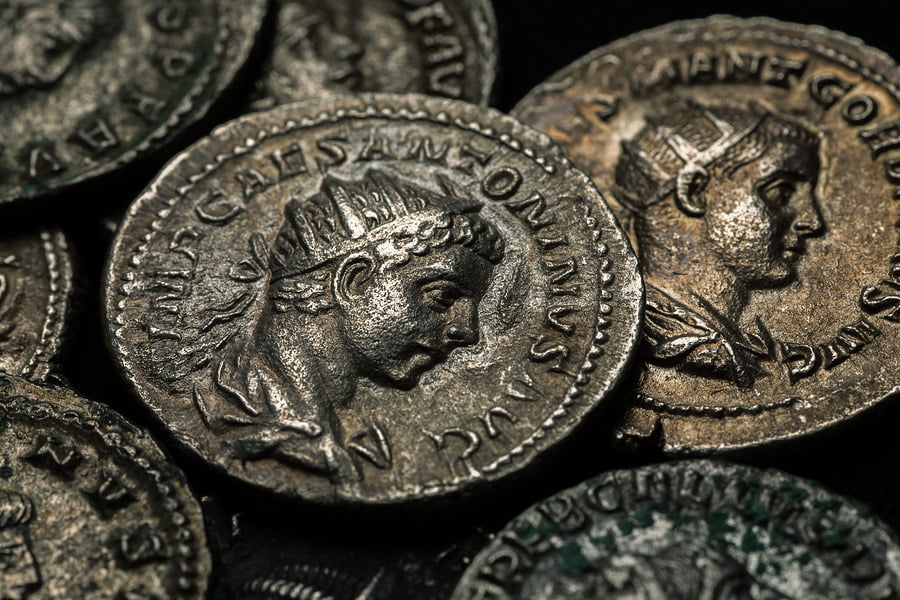
[Jesus said] “Show me the coin used for the tax.” They brought Jesus a denarius. Then he said to them, “Whose head is this, and whose title?” They answered, “The emperor’s.” Then he said to them, “Give therefore to the emperor the things that are the emperor’s, and to God the things that are God’s.” When they heard this, they were amazed; and they left him and went away. [from Matthew’s Gospel 22:15-22]
As coins and other currency vanish from our pockets and purses, it is not only Caesars’ image, but all those other icons which we now longer glimpse at each purchase. We have an ashtray in our old Land Cruiser stuffed with coins, some fuses and a corkscrew – all of them signs of an age which is fading, or certainly less familiar to our touch.
Debates about taxation are neither new, nor fading, and the Pharisees’ malign attempt to ensnare Jesus mimics the clumsy work of a tabloid journalist, or the chorus on Sky after dark.
When faith engages with the culture in which it is exercised, there is always the danger that we begin to equate them with each other, as if they are similar. Discipleship and the economy frequently exist alongside each other, with critique and challenge, but blending them together does both a disservice.
Living our faith within our community is precisely where most of us are called; how we spend our money is often a reflection of the priorities to which Christ has called us. Notwithstanding, the call to discipleship is a more profound invitation than that of the tax office.
We watch, even now, as “christian nationalism” (lower case intended) pervades much of the political and religious conversation in places like the United States. Heresies, both minor and monstrous, are hallmarks of this travesty, such as the punishment of immigrants being falsely equated with scripture, or the nationally televised execution of a criminal heralded as a sign of righteous judgment. Ironically, the biblical responsibilities of paying tax go largely unremarked or avoided altogether.
When Jesus calls attention to the icon of Caesar on the coin, he intentionally draws our eye toward God and thus, immediately, to our neighbour.
Where do we see the image, the icon, of God? First, always, in Jesus. Then, in our neighbour. Iin each other.
The early church understood that the affirmation “Jesus is Lord” was more than a liturgical faith statement. It was profoundly political; a realignment of priority, of faith, of life.
The question about tax is classic misdirection. Jesus is not fooled. The answer he offers is clear in its intent. When we attend to “the things that are God’s,” it is to our neighbours – to the poor, to the marginalised, to our enemies – that our eyes and our hearts are opened.
In a few verses’ time, Jesus will be asked which is the greatest commandment, and he will tell them to look first to God in love, and then to the image of God which surrounds us. Love God, love your neighbour as you love yourself.
Any claim to faith in Jesus which draws us from this imperative is essentially false. We, each of us, bear the fingerprints of God. How we live will not be measured by income or expenditure, but by how we respond to this most profound assertion: we are in the image of God.

